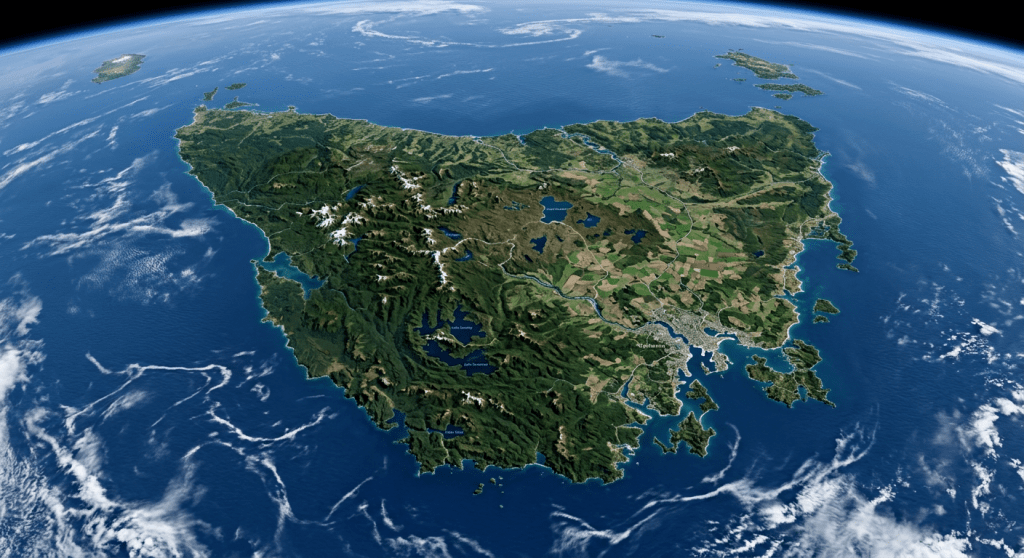
Suppose an island appears in the Pacific Ocean. An island that has never existed before. Many people of the world decide to settle it, until it has a similar population and settlement pattern to New Zealand. We can guess that the islanders would want their own government. They would want it to be democratic. And since they have no tradition of an unwritten constitution, they would have to create a written one. So what would that constitution look like?
This is a thought experiment for coming up with an ideal constitution. Against Elections, a book that was my most recent review, had a blueprint for a government run entirely by sortition (random selection). This inspired me to think of a blueprint for a government that is closer to what I envisage, a hybrid of assembly democracy and familiar representative democracy.
First though, it is important to consider the assumptions behind it.
Assumptions
Just as modern representative democracy required cultural change from early modern times, achieving a better democracy will require a new kind of cultural change. As John Keane notes, Latin America was the most democratic region of the world on paper in the 19th century. In practice, the ideals the countries’ constitutions were regularly spoilt by corruption, extreme inequality, demagogues and military coups. Only in the 1980s did stable democracy emerge, and it is now backsliding. In this example, I assume that the island has undergone a similar change to enable a more democratic culture.
So one thing I assume here is that citizens’ assemblies can become accepted by the public as a way of making the major policy decisions. Although not everyone will support each decision, and no-one will support every decision, there is a general belief that they are the best way to make the key decisions. Whenever a citizens’ assembly recommends a proposal, the government is expected to implement it, unless they can think of a good reason to reject it. They can also ‘marinade’ the proposal – wait to see if it gets wider public acceptance before going ahead. A government that refuses to carry out the proposals of a citizens’ assembly will be seen as arrogant. One that agrees to but fails will be seen as incompetent.
I believe this is possible because it’s similar to how trial juries are accepted today. Even when trial juries make unpopular decisions in high-profile trials, those decisions are widely accepted as legitimate.
It also assumes that an assembly culture has developed so that neighbourhoods are expected to have a local people’s assembly. These assemblies give people a chance to have a meaningful say in how their local area is governed, organising things like festivals and clubs. These assemblies are the largest gatherings of a wider deliberative culture. Politics is no longer a subject that people avoid talking about because it risks tribal arguments. Instead, deliberation is routine in coffeehouses, bars, home kitchens and meetings of friends. More people have experience with it and therefore they better understand how to listen and handle disagreement.
The deliberative culture means that people are more interested in politics and talk about it more often. And after all, to invert a famous quote from Martha Gellhorn, being interested in politics means being interested in your standard of living, your health, your job, your rights, your freedoms, your future or any future.
This can only be possible if the tribalism of modern party politics gives way to a new political culture. Perhaps parties will still exist, but more like the parties of 18th century Britain, except this time representing the whole of society rather than the upper classes. They are viewed with suspicion if they are seen as straying towards “party culture”, led by an insular elite instead of the citizens’ assemblies. It is also possible that an entirely post-partisan democracy may emerge.
There must also be great change to the media culture. Sam Freedman laments how, here in Britain, recent governments have devolved into “government by Daily Mail headline”. I suspect that a new deliberative culture can tame the divisive and destabilising effects of both traditional and social media, just as the deliberative culture of the Enlightenment, though more confined to the elites, may have tamed the effects of the printing press.
This is not a utopia of perfection. Most likely there will still be bitterly divisive political issues, disproportionate influence of the rich and the well-connected, popular and sensible policies that don’t get done and a political class that thinks differently to everyone else. But it would be an improvement on what we have today.
Basic structure
My proposed constitution favours a parliamentary democracy over a presidential or semi-presidential system, and the Continental model (i.e. with a proportional voting system) is favoured over the Westminster model. The reasons for this are:
- In modern times, the biggest risks of a coup have always been in the executive branch, either the head of government or the military. The best way to check these risks is to have this branch to be subordinate rather than separate.
- An elected head of government places a lot of formal and informal power in the hands of one man, or less likely one woman, as does the Westminster model. This ought to be avoided.
- Elected presidencies are more likely to attract outsider candidates, which can be a good thing but it makes them vulnerable to demagogues. A better way to absorb outsiders would be to allow them to gain a presence in Parliament rather than seizing the centre.
- It allows for quick and easy changes of governments in the event of an emergency or if the incumbent government is seen to forfeit its mandate. This can be done through either a vote of no confidence or a snap election.
- The system is used by all the Nordic countries, by many measures the world’s best-governed. It is also used by most other countries that are regularly scored highly for democracy, like New Zealand and Ireland. This may be due to other factors, as the parliamentary system is common in Western Europe, but it’s worth modelling a new constitution off the world’s most successful democracies.
No system is perfect. The multi-party politics of the Continental model can leave voters frustrated by deadlock and lacking any sense that the government is accountable. My constitution aims to use citizens’ assemblies to break the kind of deadlock that emerges.
Parliament
The national Parliament will have two chambers:
- House of Citizens: 150 randomly-selected citizens.
- They are selected from among the participants in other citizens’ assemblies and they serve staggered terms of 18 months, with one third being replaced every six months. This is modelled off the one of the two permanent citizens’ assemblies in Ostbelgien. The House of Citizens is designed to be more permanent and trained in politics than a regular citizens’ assembly, but not as much as an elected one. Its principal purposes are agenda-setting and approving laws.
- They can dismiss executive officials with a two-thirds majority. It is too unclear what the consequences would be of allowing them to dismiss them with a simple majority.
- House of Representatives: 150 elected representatives.
- They serve a term of three years. Modern national parliaments usually serve for 4- to 5- years, though Australia and New Zealand have 3-year terms. The usual argument for this is that it gives time for governments to implement policies that have an effect, which is less relevant if the governments are instead judged more on how well they follow the decisions of citizens’ assemblies.
- They would be elected with single transferable vote. This system is good because it’s proportional but can provide local representation (seats can have as few as 3 members). It can work with both a partisan and non-partisan democracy, unlike list-based systems that require parties to exist.
- Vacancies would be filled in two stages: a by-election would be held in the constituency to choose two nominees, and a sortition panel of the constituency’s voters would choose one as the replacement. This allows a democratic way to fill vacancies while sidestepping the problem of STV by-elections.
- They elect the Prime Minister and approve the appointment of Cabinet ministers.They can trigger early elections with a simple majority vote, which must be held with several months’ notice. There’s no point having the chamber continue in office if most of its members don’t want it to.
- They can also with a simple majority vote oust the Prime Minister and Cabinet with a “positive vote of no confidence” – but only if they specify a new Prime Minister.
A bill can be initiated in both chambers and must be approved by both to become law. Both chambers also have the power to call at least three citizens’ assemblies per year.
The executive branch
The head of state is the President, but this is a ceremonial post. The President is elected by the House of Citizens, conducts ceremonial duties and has important emergency powers. The President signs bill into law or can refer them to judicial review, but if the bill then passes judicial review it is enacted without the President’s assent.
I separate the head of state and head of government because heads of government can be controversial figures. It’s better to have high ceremonies of state done by someone who stays above politics.
The head of government is the Prime Minister, the leading member of the Cabinet of ministers. Any members of the House of Representatives who serve on the Cabinet go on leave from the chamber and are replaced by a substitute, though they can still attend its debates. The Prime Minister must be appointed from the House of Representatives but this is not required for other ministers.
Despite my preference for decentralising authority, I stop short of having a collective head of government. Having a single figure puts an accountable figure and human face at the top of the government.
As noted above, I’m not convinced by the need for separation of powers. However, it does use the system where Cabinet ministers go on leave from Parliament, like in the Netherlands of Sweden. This is because it underscores that they serve Parliament rather than lead it, and because serving on the Cabinet would distract them from serving their local areas.
Local government
At least two levels of local government would exist. In urban areas, these would be towns/cities and neighbourhoods. In rural areas, these might be rural districts and villages. Other layers may exit such as regions or metropolitan subdivisions (like the London boroughs).
City governments would be required to have a citizens’ assembly and an elected council with a term of two years.
I’m undecided on whether to have elected mayors. Studies in the US find that the council-manager system, with a non-partisan manager appointed by the council like a prime minister or corporate CEO, results in more efficient administration but less democratic accountability than a stronger mayor system. This constitution leaves that question open.
A neighbourhood is defined as an area that can support a local people’s assembly. These look after the local area and its people, as well as being important to the local participatory budgeting process. Neighbourhoods may also have councils which are either elected or selected through sortition, and serve for no more than two years, perhaps less. The constitution largely leaves open the question on how they should be organised.
Elections may not be necessary if there are other routes to solve the problem of participation. I favour allowing flexibility because every neighbourhood is different. Neighbourhood government would work better if it depended on local relationships rather than a one-size-fits-all solution imposed from above.
Some levels of local government may have a “thin tier” of local government. They may have a citizens’ assembly that meets once a year rather than a proper council and local government, and their decisions may be adopted either from the higher tier of government or by an agreement between the lower tiers. This could suit areas like a chain of distinct towns that form a distinct urban area, or a suburb of a larger city with a population of 20,000.
This is designed to provide flexibility for the different layers of local settlement.
Bill of rights and judiciary
The courts form an independent branch of the government. Judges are appointed by an independent appointments commission and confirmed by a separate citizens’ assembly.
I considered allowing the House of Citizens to appoint judges. However, there is a risk that the appointment of judges might get caught up with legislative bargaining, so it is better to have a separate assembly.
A Bill of Rights would have both basic and social rights. The basic rights would include freedom of speech, assembly, association and religion, as well as a right to life, rights relating to trials and protection from discrimination. It would also have a list of social rights, like in Spain, such as a right to education, healthcare, family and a healthy environment. The basic rights take precedence over the social ones.
A law passed by Parliament can override any of the basic rights as long as the bill states which right is being overridden. So the courts can strike down a law, but if it’s struck down for contradicting the Bill of Rights, Parliament can get round that by re-passing the law with a clarification that it did mean to override the right. The courts cannot strike down a law for merely going against the social rights, but they can issue a “declaration of incompatibility”.
I prefer a system that protects minority rights through majority rule, not court cases over a constitution that can only be amended with a supermajority. That may sound like a paradox, but as A. J. McGann points out, majority role is good for minority rights because:
- Supermajorities can sometimes protect minority groups, but only if they favour the status quo – usually privileged minorities, not disadvantaged ones. A great example is how segregationist senators in the United States used a 2/3 rule to block civil rights laws. Majority rule makes it easy to pass laws that help disadvantaged minorities and fix past injustices.
- Majorities are not as fearsome as they look, because if two bills have majority support, the majority who support one is often different to the majority who support the other.
- Majority rule encourages governments to pass laws that will remain popular in the future, as any law they pass can be easily overturned in a future parliament.
- Many countries with relatively few checks on majority rule, like the Netherlands, Sweden and Austria, have fared relatively well at protecting minority rights.
The override clause is based off a provision in the German constitution.
Amendments to the constitution
An amendment to the Constitution must be proposed by a two-thirds majority of the House of Citizens, then approved with a simple majority of the House of Representatives in two successive Parliaments (i.e. before and after a single election).
For similar reasons to the above, it is relatively easy to amend the constitution. I have mixed feelings on requiring a referendum. Instead, I combine requirement for a supermajority in the House of Citizens with Sweden’s requirement for re-approval after the next general election.
Constitutional change in practice
Of course, such an island will never exist in real life. Democratisation has worked best when countries have combined it with their existing traditions, and that will continue to be how it works best in the future.
How this would work here in the UK:
- The monarchy would be retained.
- The House of Lords would become a ceremonial gathering, like the Order of the Garter. Its role would be replaced with the House of Citizens. At first the House of Citizens would have similar powers to the House of Lords, the power to delay laws but not veto them, but eventually it would gain a full veto.
- The House of Commons would be retained, but with a proportional voting system. It would still sit on green seats in the Palace of Westminster, but as the current chamber is too cramped to seat all its members, it would move somewhere else such as Westminster Hall or a covered courtyard.
- The Prime Minister would still live at Downing Street and the building would be used for ceremonies and important meetings. (On an unrelated note, the building is too small, so the prime minister’s regular office would move elsewhere.)
- Ideally it wouldn’t, but the country’s constitution may well remain an unwritten mess. If so, there would be a clearer understanding that constitutional laws require extra approval and the courts can strike them down if this is not followed. Some judges have argued that this already possible, but it remains unclear. The current constitution places too much faith in politicians being “good chaps”.
- A new local government structure would be created based on four tiers: devolved/regional, county, town/city/district and neighbourhood/parish. It would have some flexibility. The Celtic nations may have no role or less role for the county layer, while in England the counties may be more important than the regional layer. The fourth layer may be more important in rural areas than in towns, and in London the middle two may be merged into its boroughs. ‘Thin layers’ may also be added.
- Local assemblies may grow out of existing public meetings, especially in parishes (villages).
Likewise, an implementation in the United States should create a government that still looks recognisably American. So it might have a President, Supreme Court and a two-chamber Congress. The Senate could become a similar citizens’ assembly to the House of Citizens mentioned above. An elected Presidential Council could be added to limit the power of the President or even make the office ceremonial, while still keeping the constitutional tradition of three branches. France would still be a republic, Germany would still have states, and so on.
The goal of the thought experiment isn’t to suggest these things should be changed. It’s about thinking about where places should move towards.



 Assembly Project
Leave a comment