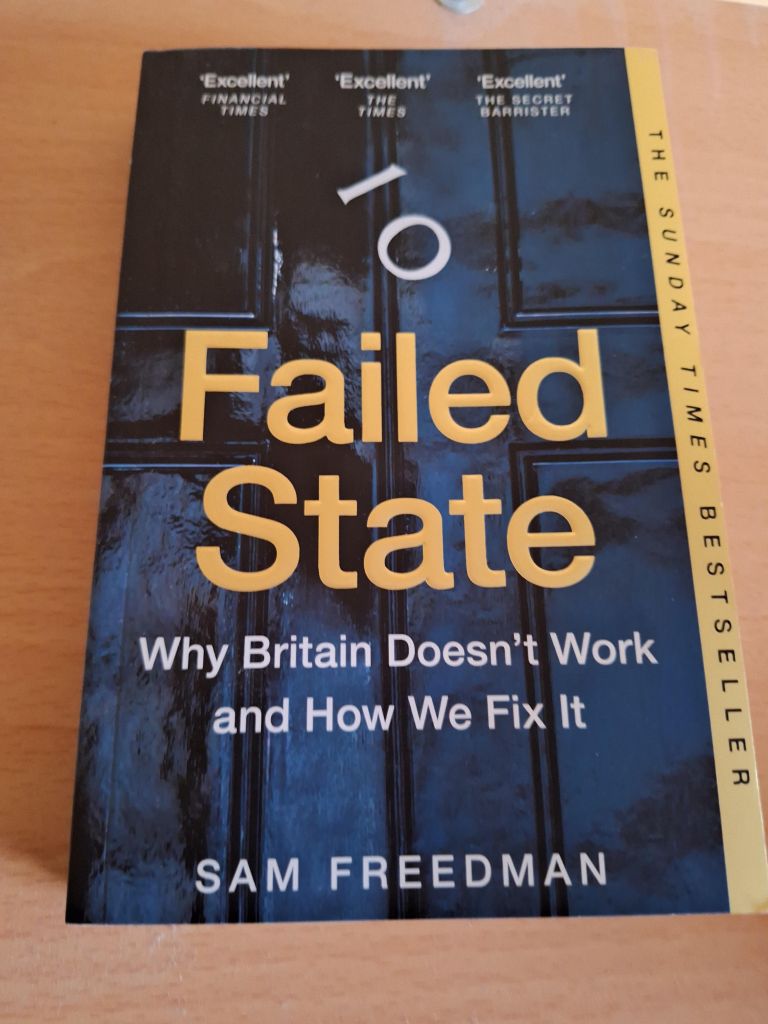
If future governments fail in the way that recent ones have, we will hit a point where the public’s patience snaps altogether and they try more radical alternatives on offer from extremists and charlatans. […] And when it does, politicians will find themselves asking: why didn’t we do things differently when we had the chance?
Sure enough, polls now suggest that if an election was held today, Britain would elect a far right government for the first time in its history. That prescient quote caps off Failed State (2024), some excellent analysis from Sam Freedman on what’s wrong with the Britain’s system of government.
Like Ian Dunt in How Westminster Works… And Why It Doesn’t (2023), Freedman tries to analyse what has gone wrong with British politics by looking at the functioning of the political system rather than parties, individuals and voters. He appears to have written his book independently from Dunt, so it’s striking how they come to many of the same conclusions, from singling out Chris Grayling’s disastrous privatisation of probation to advocating an end to Budget Day.
Sam Freedman has been on a journey. He previously worked in advisory roles for the right-wing think tank Policy Exchange and then at the Department of Education during the controversial tenure of Michael Gove as its minister. He now runs one of the UK’s most popular politics newsletters on Substack, Comment is Freed.
You get the impression that he has become disillusioned with right-wing politics, but as with Dunt’s, the best thing about Freedman’s approach is that he doesn’t play party games. Yes, he says, “having Boris Johnson and Liz Truss in charge will always make things worse.” But there is a good reason why Rishi Sunak and Keir Starmer, both far better-suited to running a country, have run into severe problems of their own. The title may be exaggerated but the system of government is profoundly unfit for purpose.
Though Dunt also devoted a chapter to the media, Freedman’s book has a wider focus. He discusses not just the workings of Westminster, but also related matters such as private sector outsourcing and local government. The latter was something that I wished had been discussed in Dunt’s book, and is perhaps the most relevant to this blog.
The sorry state of local government
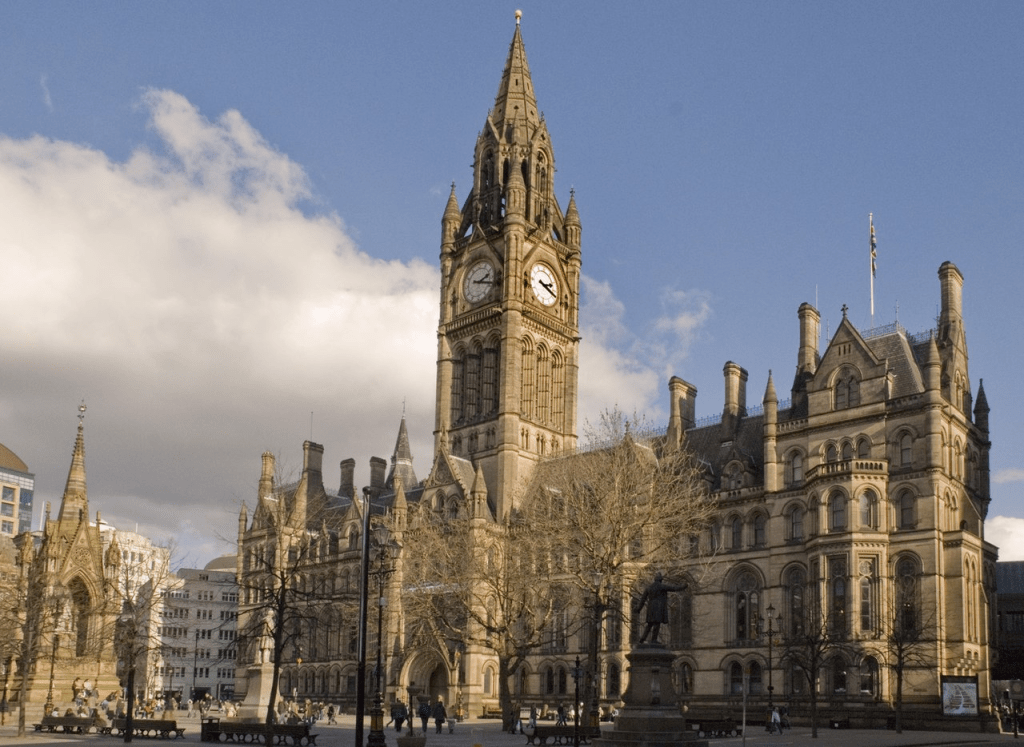
Manchester Town Hall
Compared to the rest of the Western Europe, the British state is absurdly, stupidly centralised. Much of England has no regional government, or else a feeble one. Among 38 OECD countries, the UK has the second-highest average municipal population after South Korea and the third-lowest subnational government spending as a percentage of GDP after Costa Rica and Greece. Then there is the micromanagement:
In recent years, this has reached farcical levels. In 2014, the Coalition government trumpeted ‘the first ever guidance on weekly bin collections’ from central government, replete with a £250 million ‘weekly collection support scheme’, that councils could bid for. Today, we have rules preventing councils from: putting up road signs warning of hedgehogs crossing roads; installing a cattle grid; publishing more than four newsletters a year; or holding meetings online.
One could argue that it dates back to Anglo-Saxon times. The 19th century saw local governments thrive, but governments in the 20th and 21st have gutted their power.
Part of the problem was that local governments were sucked into Westminster politics; in 1965, only half of councils were controlled by parties or coalitions of parties, as independents were commonplace. By the mid-1980s, that had risen to 84%. The clash between Labour-controlled big city councils and Margaret Thatcher’s national government led to the latter abolishing some of the former and crippling councils’ powers to raise funds.
Labour governments were also guilty of power-grabs, often lured by the view that centralisation would bring equality. Even the celebrated creation of the National Health Service was one, but it could be made more localised, like the Nordic public healthcare systems. As Freedman notes, “In practice, centralisation has not led to equality but to extreme economic divergence between the south-east and the rest of the country.”
Finally, regardless of their political stripe, governments can’t resist the urge to do things themselves. But it always backfires. Ministers become overwhelmed, having to make decisions over matters like the funding of schools and hospitals, which in other countries would be dealt with at a local level. Ian Dunt notes that ministers have to make dozens of decisions after work.
The only good news in recent years is that governments have sometimes acknowledged that it’s a problem. Freedman is optimistic about regional mayors. Any handing of power downwards is probably good, especially for metropolitan areas and counties. But these authorities have haphazard and weak powers given to one man (or more rarely, one woman) rather than a proper council. And they are being offset by yet more negative developments.
The government should be empowering more local units, which people identify with far better than somewhere like ‘Heart of Wessex’. Instead, many district councils have already been merged into unitary ‘super-councils’, leaving many towns like Northampton, Shrewsbury, Aylesbury, Durham and Salisbury with only a parish council. Carlisle, a city with a high risk of flooding, has no council to represent it at all, only a county council above it. Labour now plans to merge the remaining district councils, including my local one.
It is assumed as an article of faith that centralisation is more efficient, but there is no evidence to support this. No-one is particularly happy about it, and the only reason they don’t draw much protests is because the existing councils are themselves unloved and meaningless.
So what can an assembly movement do in a country that is already short of routes for assemblies to have an impact and losing what little they have left? The experience in Frome shows that despite their lack of formal powers, even parish councils can do a lot if they try harder. Besides their formal powers to “do anything that individuals generally may do” since 2012, they can have a lot of informal clout, as the only people that can claim to democratically represent their settlement.
Civil disorder
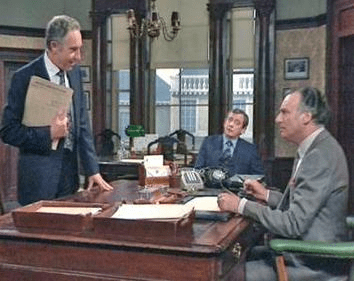
Sir Humphrey Appleby (left) talking to Jim Hacker (right)
Frustration with the civil service is nothing new. One stereotype of a civil servant is Sir Humphrey Appleby, a character in the ’80s sitcom Yes Minister who regularly sabotages the plans of his minister. Over time, the stereotypes changed. Appleby was implied to be a conservative figure, not in the partisan sense, but as a man from a privileged background who fought to keep his world the same. He was inspired by the civil servants encountered by Labour ministers in the ’60s.
Even as it aired, the stereotypes of civil servants were changing. Over 20 years later, The Thick of It portrayed Whitehall as being overrun by spin doctors and special advisors. Freedman argues that the trend has so far not been politicisation, but appointing lackeys and increasing executive control. Margaret Thatcher had some suspicions that civil servants were left-wing, but under Conservative governments after Brexit, it turned into a state of utter paranoia.
The result was a cycle of dysfunction. Things weren’t being done properly, so governments gave ministers and their advisors more control over the civil service who took the blame, which made it more dysfunctional and so governments became worse. Freedman cites the example of Dominic Raab, who bullied his civil servants. Rather than seek their expertise for his Bill of Rights proposal, he drafted it alone and the result was a shambles that never became law.
What should an ideal civil service look like? Freedman makes the argument that because of the lack of power restraints on the British government, it has been necessary for a strong and politically impartial civil service, in contrast to the US and Germany that have a lot more politically-appointed posts.
There is genuine inefficiency, but top-down attacks and reforms rarely solve it. I’ve worked for a public body that went through a round of layoffs, but the disruption and damage to morale probably offset whatever cost savings came. A successful reform should look at the incentives civil servants operate under, and think how to reward the right things.
In his books on Independents for Frome (IfF), reviewed here and here, Peter Macfadyen talks about their experience with civil servants (known in local government as officers). When his party took over the town council, the chief executive was hostile to them and soon resigned. Others were also suspicious of the upstarts. But IfF worked to win them over and create a better environment for them than what they had before, while also eliminating some unnecessary roles.
The other power centres
Sam Freedman also makes some other welcome points:
- He is critical of the culture of media obsession and spin that has developed since the ’90s. He argues that governments should focus on governing well with good policies, rather than maintaining the appearance of governing well.
- He notes how a companies like G4S and Serco have been given contracts after being investigated for fraud. Freedman argues that while some services can benefit from outsourcing, this can only happen under certain conditions: competitive markets, measurable outcomes and a way to cope with risks such as cancelled contracts.
- Like Ian Dunt, he suggests abolishing Budget Day announcements, as it results in policy changes that are either ill-conceived or pointless.
- Also similar to Ian Dunt, he is not especially fussed about abolishing the House of Lords, saying that any reform to it should avoid the current “careerism” of the House of Commons.
- He makes the case that governments have been passing more performative legislation. This is difficult to measure, but he notes how it has become more common for governments to pass laws enshrining targets, which do nothing to help achieve them.
- The edition I have of the book contains a forward from last January. He notes that after coming to power in July last year, some Labour ministers and advisors read his book. Perhaps that’s why a White Paper even mentioned cattle grids. There has at least been acknowledgement of the need for system change, even though they have also fallen into many of the same traps.
Perhaps the only thing missing from the book is more of what was promised in the second part of the subtitle: solutions. There are some and they’re good sense, but there are less than Dunt’s book, which I still felt was not offering enough. This also needs the perspective that for all the dysfunction in Britain, this is part of wider trends that are affecting other countries too.
I don’t think that solutions will come from any parties on the current scene. Even the Liberal Democrats and Greens still think it’s a matter of having the right party in power. What would really change things would be a radical, assembly-based political party. A citizens’ assembly would make decisions on how to reform the government and would offer legitimacy that could stop it from being caught up in political infighting.
For too many politicians, it is tempting to ignore the structures the government because voters are not especially fired up about systems of the government. But as Freedman notes when discussing how to fix local government:
Frankly, voters don’t really engage with the technical details of any policy area (nor should they have to). They want better services and the benefits of more economic growth: they will reward politicians who provide that.




 Assembly Project
Leave a comment