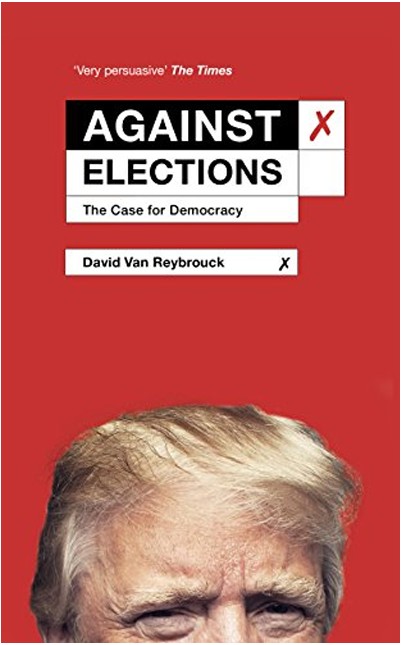
What a fitting cover!
The title Against Elections: The Case for Democracy (2013) may sound like a contradiction to most people. It shouldn’t be. In the Western world, we have an ingrained view that “democracy = elections”. But David Van Reybrouck, a Belgian historian and author, makes a provocative but strong case in this book that we’ve been thinking it wrong.
He does not argue against elections altogether, but instead against “electoral fundamentalism” and for using other processes like assemblies chosen by sortition (random selection) to bring governments closer the ideal of democracy, a system where the people have a genuine say in how the government is run. It’s a process he championed through the G1000, a global assembly that he founded. If that sounds like a new idea about how to do democracy, it is also an old one.
Symptoms and diagnosis
The book has four parts, themed around a medical analogy: “Symptoms”, “Diagnosis”, “Pathogenesis” and “Remedies”. The diagnosis is “Democratic Fatigue Syndrome”, with symptoms such as growing voter distrust of politics in many different democracies, declining election turnout, increasingly ineffective governments and growing support for the far right. Originally written for a Belgian audience with an eye on the wider world, it was translated into English a few years later by Liz Waters.
This book was certainly timely, with the English edition coming out in the year of the rise of Donald Trump in the US and of Brexit in the UK. Belgium hasn’t had a demagogue win a national election or referendum yet and nor does it have a long-resented two party system. But its fragmented party system has problems of its own. After the 2010 election, the parties took a year and a half to form a cabinet (since surpassed by an even longer impasse in 2018-20). The same problem affects different countries in very different ways.
In the years since, save for some respites, Democratic Fatigue Syndrome has by almost ever measure got even worse.* Yet polls also show that the concept of democracy is more accepted than ever. Around the world, people like democracy in theory but seem unhappy with how it works in practice. They don’t want to be lorded over. They want to be heard! Look at the “decade of protest”. Yet most don’t feel heard by the institutions of today. And they’re right.
(*The one exception is some rises in turnout, such as in France and the UK in 2017 and in the US in 2020. But that was a result of worsening division in politics, not of democratic health.)
Pathogenesis
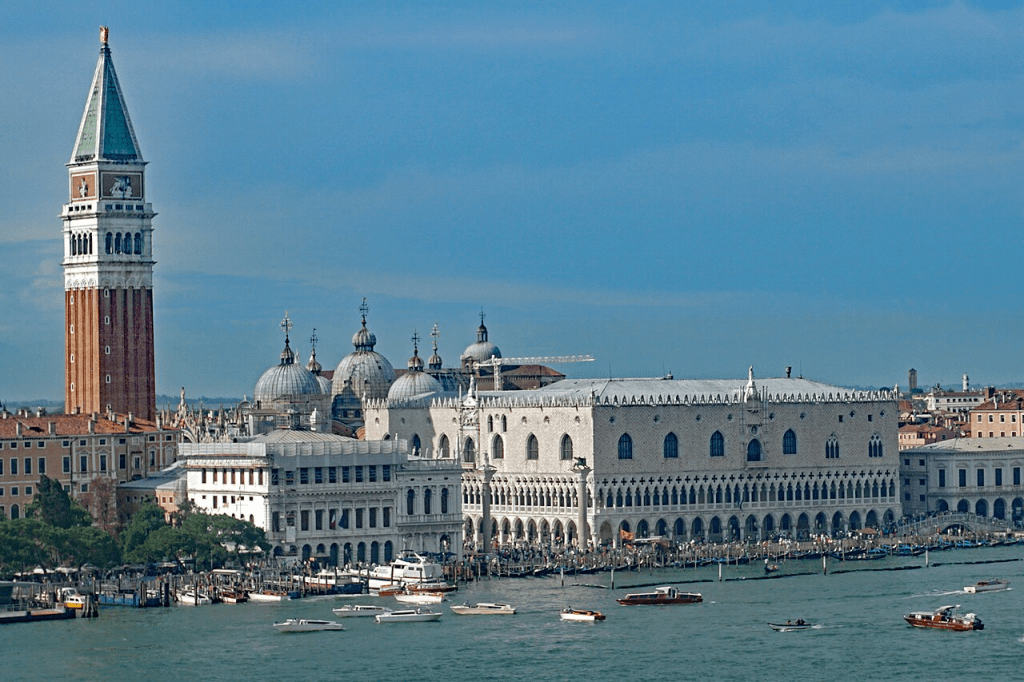
The Doge’s Palace in Venice
I am a big fan of studying history to learn from it. Much like John Keane in The Shortest History of Democracy and Roman Krznaric in History for Tomorrow, Van Reybrouck looks to republics in ancient and medieval times in order to understand how we should look at it today and where it could go in the future. He makes a convincing challenge to our “electoral fundamentalism”. It turns out that many historical republics relied more on sortition than election.
Not surprisingly, Ancient Athens becomes an important case study. Athens is widely (and incorrectly) seen as the “birthplace of democracy” without noting that it was a very different way of viewing democracy. I was especially interested to read more about the medieval city-states, such as the Republic of Venice. It was led by the Doge (“Duke”), who was chosen by a complex ritual involving several rounds of sortition and election. At one stage:
…the youngest [councillor] went to St Mark’s Basilica and approached a boy aged eight and ten at random. He was asked to join the conclave […] The innocent child’s hand drew the names of thirty participants who were then whittled down to nine in a further round.
As absurd as the Venetian system was, there is a reason why it lasted hundreds of years. Pure sortition risked putting an unpopular candidate in the office. But whereas pure election risked a popular but polarising candidate, the ritual worked well for dark horse candidates who were overlooked at first but were able to gather support as it progressed.
This did not go unnoticed during the age of the Enlightenment; Montesquieu and Rousseau argued for sortition. To add few examples of my own: Earlier that century, the UK introduced sortition for jury trials. Later, it was mentioned Thomas Paine’s Common Sense pamphlet, a major spark of the American Revolution that sold one copy for every five Americans. He suggested a small role for sortition in his proposal for an American government.
The turning point came with the American and French Revolutions, which soundly favoured election over sortition. Incredibly, sortition wasn’t so much rejected as much as not even considered. You get the impression that the new elites had quietly realised that they could create an “elected aristocracy”.
I shall add as well that democracy, like power, is present in our everyday lives. A local association like a tennis club or just a few friends gathered for a drink will probably have a form of democracy — this is associative democracy. In many cases, these groups are run democratically without having to elect anyone or vote on decisions.
Remedies
Van Reybrouck discusses the beginnings of the movement for citizens’ assemblies, including the early experiments by James Fishkin and British Columbia. Though he shares my caution about suggesting that sortition could replace elections entirely, he floats a proposal from Terrill Bouricius of a government that operates entirely by sortition. Van Reybrouck describes it as “exceptionally exciting”. My view is more measured; I do find it an interesting thought experiment. It’s designed to tackle the five dilemmas of deliberative process:
- Size: It must be big enough to include a range of perspectives but not so big that the discussion becomes unwieldly. Modern citizens’ assemblies square this circle somewhat by dividing into small groups as a result, but even they tend to have an upper limit of around 150.
- Duration: It should last long enough to have a good discussion but not so long that it becomes an exclusive clique.
- Selection: It should ideally be open to anyone who wants to take part, but this will skew to the more affluent and educated citizens.
- Deliberation: Its discussion needs to avoid the dangers of groupthink.
- Power: It should have as much power as possible but this power puts pressure on the participants. (And, I will add, could lead to them recommending something that’s unpopular with the wider public.)
Bouricius’s proposal addresses this by using six types of assembly, each chosen by sortition and most with tenure of about three years:
- Agenda Council: A large assembly with a long tenure that picks the topics in need of legislation.
- Interest Panels: Open to anyone, many small panels meet for a shorter length to study an issue recommended by the Agenda Council.
- Review Panels: The most like a modern citizens’ assembly, this assembly comes with proposals based on the recommendations of the Interest Panels, and is divided into small groups that each look at a certain area.
- Policy Juries: Another large assembly that’s selected more like a trial jury, this one meets only briefly to vote whether to enact laws drafted by the Review Panels.
- Rules Council: A smaller assembly sets the rules of the process, with the one rule that it cannot increase its own power. Bouricius designed the system to be flexible so that it can learn and adapt as it goes along.
- Oversight Council: An even smaller assembly effectively takes over the role of the Cabinet, overseeing the civil servants who implement laws (the executive branch).
A seventh type that has since been suggested is Evaluation Panels, like the Interest Panels but tasked with evaluating the outcomes of decisions.
Bouricius’s proposal is complex, and yet also not complex enough. The “policy juries” sound like an attempt to address the problem that a citizens’ assembly may recommend something that is unpopular with most voters, who will be far less informed about the issue than the participants. It’s an interesting proposal but I’m not sure if it would solve the problem. Voters serving on one would want to study what they’re voting on. My view is that it would be better that an elected chamber makes a judgement on how to respond to a recommendation from a citizens’ assembly.
Another is that there is no organ to address the big picture. People who study a single issue in detail (e.g. transport, defence, healthcare) might want to spend more money on it, but what if the combined agenda costs more than what taxpayers can put up with? So there should be a citizens’ assembly that assesses and maybe approves the whole of the government’s agenda, not just pieces of it.
A pure sortition government holds another problem: How can they have a mechanism where citizens can take part in the political system, with real, binding power? As Van Reybrouck notes, the historical republics had ways to allow most citizens to participate. In Athens, all of them could take part in the assembly and, similar to Florence, “50 to 70 percent” were appointed to sortition offices in their lifetime. They could do this because they were small city-states where citizenship excluded all women and most men. This is simply impossible in all but the smallest states today. Elections are one of the few processes that can give participants a direct, binding say in their government. The other are referenda, with problems of their own.
Then there’s the challenge that sometimes, voters itch for change. This is common after recessions, which is often unfair to the incumbent government, but it’s a real voter need. It can happen even in times of prosperity too (like the UK in 1997).
Finally, consider what representative democracy has achieved so far. It has created stable governments that uphold rights like free speech and that transfer power peacefully. Most rich countries have managed it for generations, despite the profound changes that technology has brought in that time. Other countries, as diverse as Brazil, Poland, South Africa and the world’s largest Muslim-majority country, Indonesia, have maintained elected governments for a few decades now. Despite the current difficulties that this model now faces, it has achieved something remarkable and a better democratic future needs to build on that, not just knock it down to build the next big thing.
Prognosis

Assemble’s House of the People, a citizens’ assembly experiment last year
The transition to representative democracy worked best when it was phased in, and so will the transition to whatever the future of democracy is. I suspect that this future will involve both elections and sortition. Rather than adopting the above proposal wholesale, it may have a two chamber parliament consisting of a citizens’ assembly and a traditional elected one. I plan to write about an ideal future constitution in a future post.
In the years since, there has been growing use of citizens’ assemblies and more evidence has emerged on their benefits. Most famously, there is the example in Ireland of how one broke years of deadlock on abortion, leading to its legalisation. Leaving aside the rights and wrongs of abortion, it was something that the Irish wanted. (Van Reybrouck discusses its direct predecessor, the Constitutional Convention.)
Yet citizens’ assemblies are not enough. A particular problem is the problem participation. No single process can be ideal here. As James Fishkin’s trilemma of democratic reform notes, an ideal democratic process scores well for equality, participation and deliberation, but having two of those things will make the third impossible.
So we need to find other processes. Unless you live in a microstate, the national government will cover too many people to allow everyone a substantial say and a social connection in how it’s governed. Not many people will be selected for a national citizens’ assembly. One way would be to have them for local governments, and to give them bigger roles, something sorely lacking here in the UK.
A new working model for democracy is possible, but it will only work if people are able to participate more, not just by voting every four or five years. This can be done through people’s assemblies that are open to all and situated in their own neighbourhoods. Besides giving people more of a say in their local areas, they can give people a firsthand experience of the assembly process. And that would encourage them to put more faith in the judgement of more distant citizens’ assemblies. The assembly democracy I envision combines both citizens’ assemblies and open people’s assemblies, and the culture of electoral politics needs changing too.
Against Elections is a welcome argument for the need that democracy should be about more than elections that is even more relevant now than it was then.



 Assembly Project
Leave a comment