Conservatism is a philosophy of sex and death
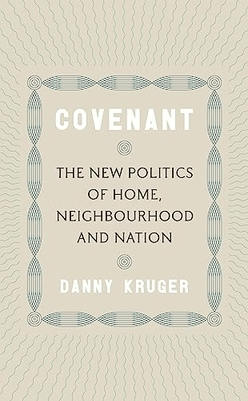
That’s an actual quote from Danny Kruger’s book Covenant: The New Politics of Home, Neighbourhood and Nation (2023) and it makes sense in context.
I read this book because I think it’s healthy to sometimes read from different perspectives to your own. Kruger wrote it to argue for a renewal of British conservatism to face the great challenges of the present, at a time when the Conservative Party were on the road to an unprecedented defeat. Like the concept of a “polycrisis” that I and others use, he notes that Britain faces a crisis of many interlocking problems – political, economic, social, environmental and security.
Kruger is the MP for East Wiltshire and the son of The Great British Bake-off judge Prue Leith. He once wrote speeches for David Cameron, including the so-called “hug a hoodie” speech. Last year, he became the first Conservative MP to defect to Reform, which he said was due to his belief that “the Conservative Party is over”.
Do not get the wrong picture from this. This book is not the rantings and ravings of a demagogue. Nor is it a simple call to turn back the clock to an imagined past or put blind faith in the markets. Kruger is a serious thinker and one of the most interesting on the British right today. Though the book often lacks even the vaguest ideas on what new policies would come from the thinking, it has valid criticisms of modern society and its isolating effects. And what I liked the most about it is how he reaches into an often neglected strand of conservatism: the communitarian strand.
It’s one that is rarely seen in politics but has a long, rich intellectual history. It’s a strand present from Edmund Burke, who opposed the French Revolution and defended the “little platoons”, to Roger Scruton, whose ideas about home, community and the natural word are influential here. Besides the conservative tradition, Kruger’s influences include Alasdair MacIntyre and Robert Putnam, who both warned that modern society was isolating people.
Covenant

Danny Kruger in 2019.
Kruger’s principle argument is:
Instead of a social contract, an imagined deal struck in the light of ‘reason’ between the sovereign individual and the totalising state, we need a social covenant. […] The meaning of the word has been well conveyed by the phrase ‘artificial brotherhood’. A covenant is a way of expressing and formalising the love – unconditional, unstinting, permanent – that can exist between people who are unrelated by blood.
Covenant is a wonderful word. I encountered it in my childhood days at church, and more recently in a Unitarian spirituality group. Unitarianism is a rare religion that is united by “covenant not creed”, an agreement among its members rather than having the same beliefs.
Kruger describes the dominant thread of history like this: Pre-modern society was built on collectivist values and tradition (“The Order”). But after the Industrial Revolution, these were gradually challenged and replaced by individualist values (“The Idea”), a trend of “self-worship”. About a fifth of the book is taken up by this abstract theorising. My view is that it’s the wrong tool to explain how a Western society has changed in that time. Philosophy has long been an elite practice, divorced from everyday life and tending to reflect its times rather than make them.
While I also sense a move to more individualist values, even as modern states have led to new ways of collectivism like universal healthcare, I put that down to how people’s own lives have changed. Since the Industrial Revolution, there have been many revolutions in how we live, move around and share information. Second-wave feminism owes much to how washing machines and fridges reduced the amount of housework and television showed what they were missing. I doubt that many participants in London’s first Gay Pride parade in 1972 had read Jean-Paul Sartre. Their campaign for more individual freedom on how to live sexually wouldn’t have been possible in pre-modern village life, where homosexuality couldn’t form a subculture if it was even noticed at all.
Yes, modern society has major failings, including the decline of face-to-face community, but I’m more inclined to blame that on the isolating effects of technology like the internet, and before that television.
Philosophy, which Kruger clearly enjoys, can help us understand the world and ourselves. But a book on politics needs to look at the challenges we face on the ground, such as stagnating wages and the rise of loneliness. It’s only rare that facts like these are cited, and they tend to be selective. He mentions the 2019 ruling against Maya Forstater, a woman who’d lost her job because of her criticisms of trans rights. It’s only mentioned in a footnote that the ruling was overturned on appeal.
Home
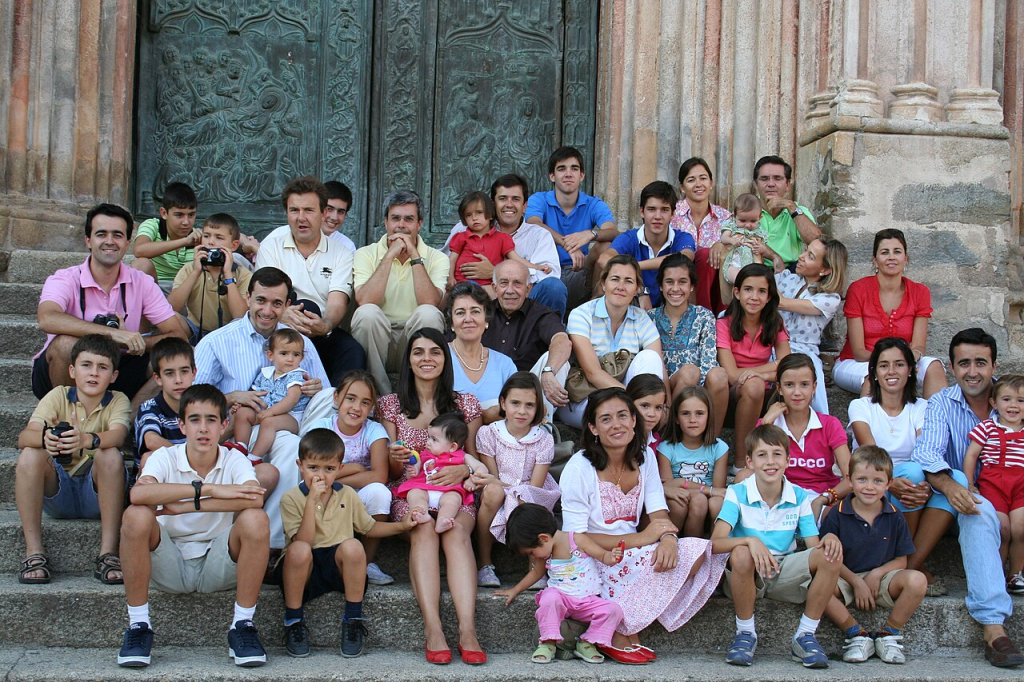
An extended family gather in Spain.
Though my blog deals mainly with how people could find belonging in their communities, my favourite part of this book dealt with another important source of belonging: the family.
I grew up in a nuclear family: a fairly isolated pod of a father, a mother and their biological children. That arrangement worked for us, but many of my peers saw their parents divorce. It has long been seen as the ideal and traditional family in Western society, but Kruger draws from David Brooks essay for The Atlantic, “The Nuclear Family Was A Mistake”. Both argue that the dominance of the nuclear family is neither a centuries-old tradition nor a blueprint for the future – it was really a mid-20th century aberration. More often in human history, people have lived with an extended family.
Unlike Brooks, Kruger again cites philosophers rather than evidence, and other studies argue that nuclear families were common in medieval England. But people are now more separated from their extended families, and the current system is indeed ridden with problems. As Russell Cooke notes, although the divorce rate has slipped, it’s becoming harder to find stable relationships. That tallies with my own experience – I’m a 32-year old man with a house and a job and I suspect I’d have found lasting love by now if I’d lived in previous decades. The system discourages couples from having children and places an unequal burden on working-class women, since stable marriages are often a luxury for the affluent and not many single fathers raise children.
This section does offer ideas, though they’re still quite vague, about making it more affordable to buy homes and raise children. Some of it is ambitious spending plans packaged in conservative values. Other times, it is the kind of social change that wouldn’t be led by politicians.
As he sometimes admits, we can’t bring back the ways of the past. Those had their problems, including their treatment of women and gays. And it is unrealistic to expect everyone to do things like staying in harmony with their partner or parents. (As Kruger knows all to well, as he himself was born to an extra-marital affair.) Families are less stable now in part because people are freer to walk away from someone like an abusive husband. How can they find a family? I’d argue that they can. One way, such as the LGBT concept of found family, is to have family-like networks for people who are not biologically related.
I advocate local assemblies partly because I believe people need a wider social circle to belong to. They could well provide social support, like Cooperation Hull’s weekly pay-what-you-can meals. But perhaps we need networks that fit between the immediate family and wider communities, “covenants” as Kruger would call them. Churches have often done this, though not everyone can be churchgoers. There is a strong argument for raising kids communally like in the Israeli kibbutz system. I’ve been in touch with Kin, who are creating a digital platform for savings clubs.
Neighbourhood and nation

Two ages of religion in Avebury, Wiltshire.
Kruger also applies the concept of a covenant to a nation:
The British are bound by something other than blood; ours is a civic not a racial nationalism, an ‘artificial brotherhood’ forged by centuries of peaceful enjoyment of the common inheritance to which all newborn citizens, whether ethnic Saxons or Afghans, are equal heirs.
So far so good, but many question remain: Can you have a healthy concept of nationhood without bringing in its wretched cousin, the bigoted nationalism that scapegoats minorities, foreigners and even many Whites who don’t conform to its ideal, and that lies to those who do? The years before and after this book was published have given us reasons to be pessimistic. And how do you deal with the fact that there isn’t always a simple answer to “Who are we?”, especially in Britain? How do you deal with the fact that some people are more willing than others to identify with a nation, its traditions and its myths? How do you reconcile that some like Kruger believe Britain to be a culturally Christian nation, and others do not?
This is where I’d argue that liberal philosophy answers the question better. Whereas conservative philosophy often insists on one answer, the traditional one, a liberal response would say: give people the freedom to decide. They can believe in a traditional view, however they interpret it, or look for an answer elsewhere. The state often avoids these decisions or if it can’t, such as when a council must decide whether it should still do prayers before meetings, it decides through democratic methods like parliaments or citizens’ assemblies. And values rooted in fairness make a stronger case against intolerance.
But that’s not enough. The problems that nationalism causes can’t just be argued away. They come when people rely on it too much for belonging. At best, you get the situation that Britain is in now: as seen in last week’s local elections, its society has been fractured rather than united. Even the future of Britishness itself is in doubt, with the devolved governments of Scotland, Northern Ireland and now Wales all led by a secessionist. At worst, you get the disasters of fascism. We must recognise that a nation is not a true community; I would call it a para-community, built on relationships that are parasocial (i.e. not quite social) rather than truly social.
The para-community of the nation can be useful. It can build welfare states, railway networks, water supplies and health services. Some people do get something from its traditions, myths and parasociality. But society would be healthiest if we treat nationhood as just one of many things we belong to, just as human beings are designed, rather than the be-all-and-end-all of our belonging. So we need other para-communities too, like our cities, counties and regions, and they need governments with real powers.
We also need to give people power and belonging in our true communities where people can meet face-to-face. Kruger agrees, lamenting “England [is] the most centralised state of its size in the world”, that local government is powerless and cliquey, and that “local residents have next to no direct involvement in the management of local life”. Once again, there are no clear proposals, though I appreciate his support for decentralising power.
And then there’s his intriguing idea that “everyone should perform ‘council service’ – a year as a part-time local councillor – at least once in their lives”. This idea overlaps with my own keen support for citizens’ assemblies, though serving on the latter is shorter and optional. Both are based on the idea that governments can benefit from calling in outside citizens for advice, and that such service can bring benefits to participants. There’s evidence that people benefit from serving on both citizens’ assemblies and juries.
The future of conservatism
Much has been said about Pasokification, the collapse of traditional centre left parties. But it’s not just the centre left that’s struggling to hold; so is the centre right. Unconservative far right forces have overtaken their parties in many countries, or in some cases like the US, taken over them. In the UK, our Conservative Party held up for longer by co-opting this element through Brexit, until it unravelled.
Despite my differences, I see the crisis of conservatism as a problem. For all their faults, they played an important role. They absorbed certain forces, such as demands to lower taxes or immigration, that could otherwise be channelled into elite coups and demagogues. When the right is dominated by the far right instead of the centre right, elections become existential threats to the decent society. Either centre right parties must be rebuilt or, as I would argue, we need to phase out party politics altogether. And the latter is only possible if we find a new way to include conservatism in the system.
I also see it is as a shame that the communitarian strand has been so absent. It briefly surfaced in David Cameron’s idea of “Big Society”. But despite a few positive developments like the 2011 Localism Act and metro mayors, his government’s austerity and education policy resulted in yet more centralisation and the loss of many little platoons like community centres. The effect of the populist right has also been dismal; YouGov found that over 40% of Britons wouldn’t date someone with opposite views on Brexit and 5% had fallen out with a family member over it. Worse may be to come.
In Covenant, Danny Kruger makes a welcome call for the right to revisit that strand, even if it’s often detached from social conditions and short of actual ideas. In the short term, I can’t see it happening. But when the time comes that the existing political order falls and we have to figure out new ways to live together, our shared interest in reviving community could be a good way forward.



 Assembly Project
Leave a comment