
Ever since my review of the first part, I’ve continued plugging away at Roger Hallam’s podcast. This one covers chapters 13 to 21, a total of 12 episodes as some chapters are in two parts. There are also three sets of standalone episodes that form trilogies, one on organising and another on the flaws of existing institutions.
You can listen to these chapters on their own, but it does help to at least be familiar with the earlier concepts of proximity and sociability. And there’s the concept of a paradigm, which I first encountered in jokes as a prime example of a word that no-one understands. What it actually means “set of concepts” or more plainly “a way of looking at things”. This becomes significant when you have a paradigm shift.
Examples of paradigm shifts include how the rise of relativity and quantum mechanics in science superseded Newtonian mechanics, how Keynesian economics superseded orthodox economics, and how the Enlightenment superseded earlier faith in the divine right of kings and tradition. Hallam suggests that the time is right for a paradigm shift to change how we think about politics but also likely affecting other aspects of life such as economics, socialisation and spirituality.
This post is going to emphasise analysis over review, as much of the strengths and weaknesses that I discussed in the previous part apply here. I would like this content to be available in more concise written formats, but Hallam has promised a book on assemblies that may do exactly that. You can read an extract from it here.
I also note that Hallam can, in the true left-wing tradition, be harsher to reformists who work within the system than to his strongest ideological opponents. This ignores that in most eras, reformists have been more successful at bringing change, especially legal change, than radicals. But not in every era, and likely not in the era we’re entering.
Nonviolence
Hallam and the groups he has founded have been accused of many things, but violence isn’t one of them. Nonviolence is one of his core beliefs. As the journalist who recently interviewed him for The New Republic notes, this is “for spiritual as well as strategic reasons”.
Hallam detests violence even when it serves good causes, for several reasons: It requires hierarchy and secrecy to work. It creates a culture that excludes women, elders and others who are not suited. It takes away the sociability factor. Finally, the lesson of history is that nonviolent rebellions are better at securing change, especially democratic, egalitarian change, than violent ones.
He mentions Erica Chenoweth’s research, and other studies come to a similar conclusion. However, this may reflect that nonviolent resistance is more likely to occur in times and places better suited to democracy and nonviolence. In South Africa and Northern Ireland, civil rights movements at first tried nonviolent methods, but the authorities’ violent responses led to the rise of violent resistance.
Media
Hallam devotes a few episodes to the media. Anyone familiar with the media knows that its purpose is not to make the public more knowledgeable, nor primarily to force people to adopt a political viewpoint, but to make money. Journalism is geared to attracting viewers (or readers or listeners) which can in turn attract income from advertising and sometimes other sources like sales and subscriptions. Even subsidised media outlets, such as the BBC and billionaire-owned papers are in practice, will still be affected by these incentives, as they need viewers to justify their subsidies.
Hallam notes different types of oral interviews:
- Short interviews, often merely confrontation that aims to get a headline for the next news bulletin.
- Long-form interviews, which are more likely to give the interviewee their day in court, but which can also slip into confrontation.
- Right-wing spaces, such as podcasts.
One Extinction Rebellion protestor was harangued in an interview for owning a diesel car. She tried to explain that she needed one. Hallam argues that you should avoid traps like these. What’s missing is a summary, but you get the impression that the best way to deal with confrontation is to not play their game:
- Say the thing they assume you won’t say: Hallam mentions the time when he was badgered by an interviewer over whether he would nationalise 90% of the economy. He just said yes to it.
- Tell a joke: He mentions the time that Russell Brand asked his interviewer if someone on a nearby computer was watching porn.
- Fire back with a question of your own: “Why do you own a diesel car?” “Why do you own a diesel car?”
- Say a meaningless non-sequitur: “Oh, 57. I’ll go with 57 because it matches the 57 varieties of Heinz.”
- Brazenly change the subject: “Okay, so you want to X, however I’d like to talk about Y.”
It may surprise many that Hallam has appeared on interviews in right-wing media, particularly those that will do long-form interviews, such as podcasts. You should take them seriously, building a rapport with the interviewers, and then you can have your day in court. He argues that progressives have made a mistake in recent years of boycotting right-wing spaces. I agree. Talking to them is a way to prevent “overpolarisation”. Even if you don’t win converts, you may at least win some respect and defuse the hostility that would otherwise brew.
Hallam cites the example of Harvey Milk, a charismatic gay rights activist of the 1970s. He dealt with the local backlash against the San Francisco gay community by visiting the very spaces where the backlash was strongest, such as Evangelical churches. He patiently bore insults and threats, which won him sympathy from moderates. Milk’s approach was courageous and the risk was real — he was assassinated by a political rival in 1978. Hopefully those taking Hallam’s advice will face far less danger.
Leadership
Hallam’s view on leadership takes a midpoint between two extremes. On the one hand, there are obvious problems with leadership of unaccountable, secretive hierarchies, if that would even be accepted by the movements he hopes to inspire in the first place.
The opposite is the horizontalist aversion to organisation, followed as a theory by postmodernist academics, and as a practice by numerous recent protest movements. Hallam shares Vincent Bevins’ view that movements like these with no leadership or organisation are missing something, because they will either fail to make decisions or shoot off in the wrong direction. A few episodes later, he discusses his experience with helping organise strike action by Brazilian delivery motorcyclists and then the A22 network of climate protests.
His case against it is to understand that power is not always oppressive. It happens in every day life: we may entrust a friend to guide us on a walk, and then another to recommend a pub. He also emphasises that power is like the Sword of Damocles: the responsibility can be a serious challenge, though at other times also “actually quite boring”.
He argues that good leadership should allow for and listen to a range of views before making decisions, more a job of bridging than controlling. He cites Mahatma Gandhi and Martin Luther King as examples of activists who listened first before making decisions. In my experience, a talented leader whose ego has gone to their head is worse than a clueless leader who knows they’re clueless but is willing to listen to those who know better.
A similar balance needs to be struck between national leadership and the autonomy of local chapters. He gives an example, probably familiar from his own experience, of an entryist group taking over a local chapter. In this case, Hallam recommends the national leadership create a new local chapter.
That raises the question: if the national leadership have how will you make sure the national leadership don’t go astray or mad with power? At this point, Hallam pulls out a missing piece of the puzzle. He argues that you should hold them to account with a sortition council — a council of randomly-selected members.
Organisation
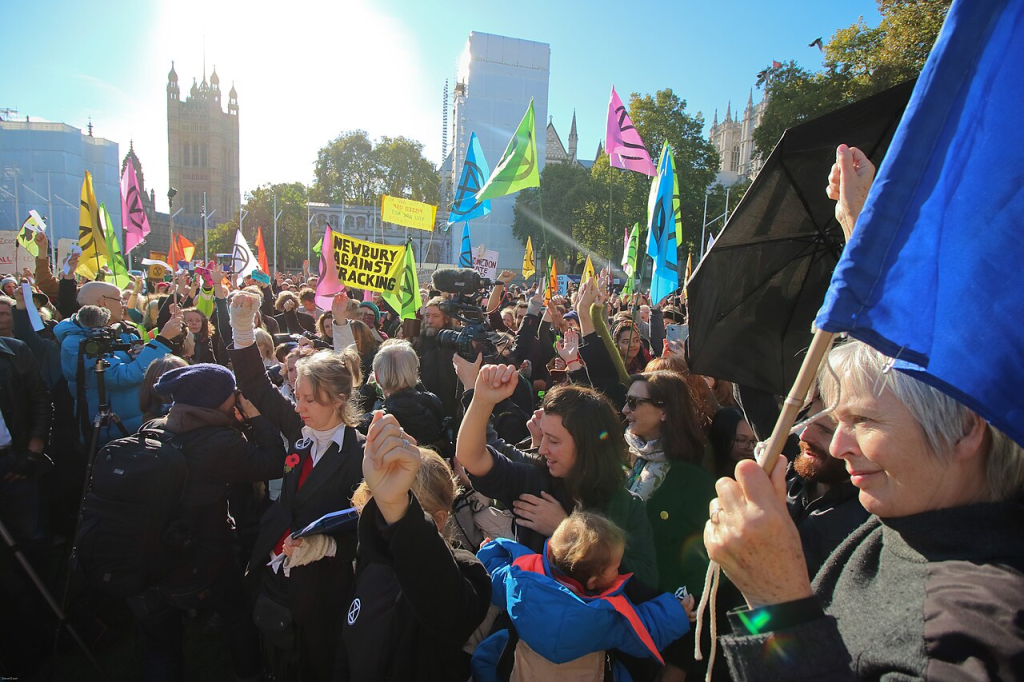
(Extinction Rebellion in October 2018, six months after its founding.)
The other episodes in the trilogy on organisation discuss how to grow an organisation. They appear to have been made with climate protests in mind, but can mostly apply to the nascent assembly movement.
He emphasises that, like business start-ups, activist groups should keep trying over and over again, learning from mistakes and keeping a record of measurable outcomes like event attendance. It reminded me of the concept of the R-number in epidemics (which I learned about four years before Covid). If their growth rate is consistently positive, small movements can go big in incredibly short spaces of time. As The Guardian confirms, Extinction Rebellion (XR) began with only 15 people in a room, was holding protests six months later and within a year was the UK’s biggest civil disobedience campaign in history.
It also puts controversial disruptive protests into perspective. It’s not just about forcing authorities to act, but also stirring people to join. Even if 80% of the public hate your protest, if 1% are motivated by what they see, you will mobilise supporters on a scale that XR did and few others have. This comes at a price: most people don’t like disruptive protests and I have shared their wariness at times. As YouGov polling notes, most people would rather you just protested in the town square. But what newspaper or TV channel would cover that?
Nevertheless, disruptive protests like XR and its spin-off Just Stop Oil hit a ceiling on what they could achieve. They found missing pieces of the puzzle but not all of them. Activists looking to start the next movement need to find a way to build on the impressive mobilisation that groups like XR achieved, but also win the support from the public needed to press for change. They could adopt a change of strategy once they reach the ceiling, or start creating local assemblies, as some XR activists and Serbian protestors have done.
Last notes
There is a lot more to discuss in these episodes than I have time to write about here. I’ve discussed less about the existing institutions trilogy, because while it will be of interest to many assembly organisers who see them as a vehicle for revolutionary change, they have less lessons for running the assemblies themselves.





 Assembly Project
Leave a reply to A movement is stirring — my experience at Rev21’s first convention – Assembly Project Cancel reply