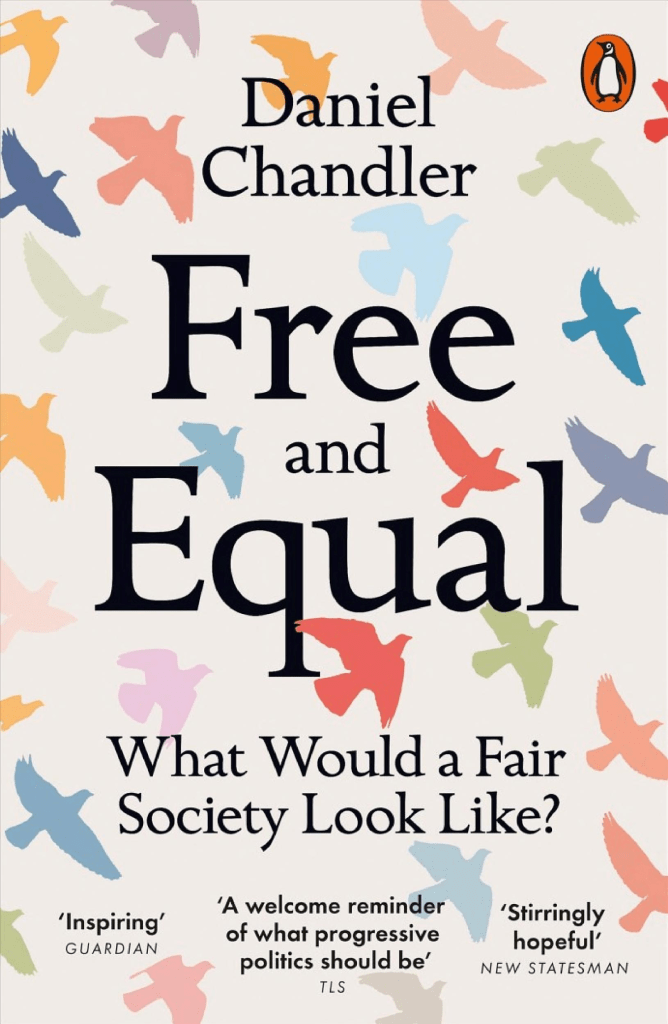
There are two types of people – those who haven’t read John Rawls and those who are politics graduates. The Harvard professor revolutionised political philosophy with his book A Theory of Justice (1971), yet is rarely discussed in the world of politics. In his book Free and Equal (2023), Daniel Chandler, a political advisor turned academic, makes a strong argument that this needs to be changed. In doing so, he produces something that left-wing politics has been missing: a vision, and an inspiring and cohesive one too. And one which, incidentally, involves quite a bit of assembly democracy.
Why Rawls? Chandler argues that Rawls offers a cohesive theory on what it means to build a fair society, answering questions such as if you can have a society that is, as the title puts it, Free and Equal, as well as questions like how to apply free speech.
But if Rawls is so great, why has he been overlooked? Part of the problem is that A Theory of Justice is more abstract and technical than accessible, although there is now a musical of the same name to explain it. And as Jonathan Rauch noted last year in Persuasion, we’ve been taking the liberal values developed since the Enlightenment for granted “like the proverbial fish that says, “What’s Water”?”. Rawls lived in a time and place where there was little need to defend them. Meanwhile, the economic side of his philosophy, with its focus on fairness, was to soon be overshadowed by the rise of market-focused neoliberalism.
But in a time of multiple crises, including a worldwide assault on liberal values from the far right, as well as climate change and economic problems, liberalism is in dire need of a vision that can inspire supporters and win over the public. It has been left with only negativity to defend itself. The neoliberal vision has lost support on both the left and right. The former are divided on what to replace it with and, in the US especially, struggle to counter an (often exaggerated) image of caring only for the identity politics of discriminated groups. Moreover, especially for more left-wing figures like Jeremy Corbyn and Bernie Sanders, many of their policies are popular but they have faced an uphill battle to sell the package.
So perhaps it’s time to revisit Rawls. And nor should we treat his work as outdated. As Chandler notes, Adam Smith and Karl Marx became far more influential after their time.
Part One: The Theory

Imagine you have to design a society where many people live. Imagine you’re going to live in that society. You don’t know which of those people you will be (the veil of ignorance). How would you design that society? What principles would underpin it? This is the original position, a thought experiment that Rawls (pictured above) offered for designing an ideal society from square one.
How does this follow? To give an example of my own: consider the question of whether that society should have slavery. That means there’s a chance that you would get to own slaves, which might be handy, but it comes with the risk that you would be a slave. Even if you limited slaveowners to a maximum of one slave, the risk of being a slave surely doesn’t outweigh the upside risk of owning one. Thus, that society should not have slavery.
In the first part of the book, Chandler summarises Rawls’s thought experiment, what principles he thought it would lead to and the arguments for and against it. Rawls concluded that you would design the society based on the following principles. To summarise, these are:
- Basic liberties principle: Above all, everyone has an equal right to the same basic personal and political rights.
- Social and economic inequality is only acceptable if:
- Fair opportunity principle: It originates from positions and offices which everyone has an equal opportunity to obtain.
- Difference principle: It benefits the worst off.
In my view, fixating on the original position isn’t important. You could justify the principles with an alternative experiment like “Suppose you would have to live the life of every single person in this society.” You could also justify them on purely utilitarian terms: “Try to minimise suffering and maximise happiness”. But Rawls argued that utilitarianism could be used to justify lots of things, such as oppressing one group to benefit another.
Rawls argued that there were personal rights (e.g. freedom of conscience) and political rights (e.g. right to vote) which were essential to a free society. In the question of how to make a society both free and equal, keeping it free comes first. And when the basic rights clash, such as in disputes between gay rights and religious rights, no right has automatic dominance over the other. Rawls rejected the view that a concept of economic freedom, other than a few basic property rights, was necessary for a free society. This had been famously argued by Friedrich Hayek in The Road to Serfdom (1944). Writing during the Second World War and the age of totalitarianism, Hayek was right to be worried, but he couldn’t foresee the Scandinavian welfare states or Augusto Pinochet.
With the fair opportunity principle, it is notable that Rawls argued for equality of opportunity rather than equality of outcome. Together, the latter two principles help reconcile a longstanding contradiction: the value that all human beings are created equal with the reality that trying to make people as equal as possible runs into the kind of problems that bugged communist economies.
For example, it makes sense that doctors are paid above-average salaries, as it encourages them to train for years at medical school and provide the community a vital service. But everyone who wants to be a doctor should have an equal chance of succeeding. Even if that chance depends on luck, it should not depend on social background. It also makes sense that night workers are paid extra and that people who go on career breaks are paid less. It may even make sense that entrepreneurs can get rich, up to a point, if it gives them an incentive to bring useful products to the market.
Part Two: The Ambition
Rawls’s principles could be used to justify many different political agendas, from radical left to centre right. In the second part of the book, Chandler argues that they should be interpreted to mean taking radical steps to build a fairer society. This inevitably appeals far more to the political left in practice, but only if they are prepared to sometimes dial back or explore alternative options. His ideas include:
- Centrist pragmatism: Defending markets in principle, wariness about hate speech laws, protecting religious freedom…
- Familiar radicalism: Scandinavian levels of taxes and spending, abolishing fee-paying private schools, universal basic income, stronger action on climate change…
- Heterodox radicalism: Workplace democracy, media vouchers to fund the media (like democracy vouchers for funding political candidates), ‘flexicurity’ approach to employment law…
On their own, they would be an appealing laundry list. But this where having the foundation of Rawls comes off as a masterstroke. It means that, even though it covers subjects that the late professor had little or nothing to say about, Chandler’s vision comes across as cohesive. It’s also realistic – it doesn’t defy the realities of economics and human nature. The only challenge would be finding the political will to get them done.
While he has many bright ideas on how to revitalise the economy, Chandler’s ideas on how to revitalise democracy are more relevant to this blog. Many will be familiar to his readers, such as calls for proportional voting systems and ending corporate influence. He makes the interesting observation that our workplaces are shockingly undemocratic compared to other areas of our lives, and discusses how to improve them. But what makes this book especially noteworthy for this blog is that he champions two forms of assembly democracy.
Chandler on assemblies
Like almost everyone who wants to revitalise democracy these days, Chandler is a proponent of citizens’ assemblies. As he argues:
[T]he key advantage of this method is the insight it can give into what a reasonably representative sample of the population thinks about a particular issue, which in turn can help to improve the quality of democratic deliberation and debate. Of course, we can find this out more quickly and cheaply using ordinary opinion polling. But random selection offers insight into not just people’s existing political opinions, but the conclusions they would reach after continued reflection.
Additionally, another disadvantage of opinion polling is that the outcomes of an opinion poll can vary depending on how the question is worded. Mark Pack has noted several examples over the years, including this one where the wording could change a response from 58% to 37%.
Chandler argues that citizens’ assemblies shouldn’t replace elections altogether, as this “would leave most people with no way of participating in the formal process of decision-making.” The foreseeable consequence he mentions is that people would disengage from politics, but there could be others – people may decide that the government is illegitimate. To my knowledge, no society has ever chosen its decision-makers through random selection on its own; even Ancient Athens had a lawmaking assembly open to all citizens and a few elected posts.
Instead, Chandler argues that citizens’ assemblies could be used in an advisory role as in Ireland, as a way of scrutinising parties in election campaigns (like Oregon’s Citizen Initiative Review for referenda) or, more radically, as a new parliamentary chamber.
Chandler also champions participatory budgeting (PBing), something I shall write more about here in the future. These are processes to get locals more involved in how their local council spends money. The exact process varies, but it hinges on discussing ideas at neighbourhood people’s assemblies. Chandler cities research in Porto Alegre, the Brazilian city where PBing originated and where around 8% of adults could attend these meetings. That may not sound like much compared to election turnout, but for public meetings, that kind of turnout is a miracle.
It also shows that PBing has a good track record for involving and listening to poorer social groups and, despite an initial gender gap, women too. That’s a relief because when it comes to the rights of women and minorities, direct democracy has a poor track record. But this seems to be a problem purely with referenda, rather than modern assembly-based approaches.
Beyond policy
Would all this be enough to save democracy from its worst crisis since the 1930s? Perhaps, but Free and Equal discusses what policies are right, not how to organise to their end. But the latter question also needs answers. It’s just not the question that Chandler was addressing, and that’s absolutely fine.
I’m firmly of the view that one reason for the decline of democracy is that we’ve become more aware of its failings. For example, we see more of the culture of partisanship and how it looks neither honest nor helpful. We’re all too aware that politicians tend to act for the party interest rather than the national interest. While Chandler writes with the assumption that political parties will continue in their present form, my view is that if we are to continue having political parties, they need fundamental change, perhaps to be more like loose banners for independents than the tribes of today. On its own that would make governing difficult, but this could be overcome by making more decisions through citizens’ assemblies and local governments.
While citizens’ assemblies have a great track record for making decisions, there are unanswered questions. What do you do if a citizens’ assembly makes a decision that most of the public don’t support, because the learning and discussion made assembly participants think differently? What do you do if a swathe of the population will believe conspiracy theories that the process was a sham?
There’s a broader problem with representative democracy, that we just don’t like being represented. A national government that rules over millions of citizens cannot please all of them at once, and nor can it offer the human community and connection that we’re designed for. We’ve become more aware that our politics is not representing us. If we carry on like this, it will be impossible to justify any political loyalty unless one resorts to astonishing feats of self-delusion.
This is why I’m also sympathetic to Murray Bookchin’s communalist vision, that we need to build “face-to-face democracy” in our own communities. Chandler may sense something similar, hence his support for PBing. There’s evidence that besides its known benefits for helping local governments spend money better, PBing is a positive experience for those involved. It would almost certainly help people overcome feelings like isolation, powerlessness and hatred of the other side.
But we shouldn’t wait for the government to start building assembly democracy. The best way to encourage it is to start a people’s assembly of your own.





Leave a comment