Something odd happened in the 2010s. As the journalist Vincent Bevins puts it:
From 2010 to 2020, more people took part in protests than at any other point in human history.
I was one of them. I marched in November 2010 against the British government’s plans to treble the tuition fees for universities. It didn’t work. Neither did the other protests against the government’s austerity program, nor the People’s Vote and Extinction Rebellion protests. The latter perhaps got more people talking about climate change, but more concretely, it prompted the government to pass laws restricting the right to protest.
As Vincent Bevins notes in his 2023 book If We Burn, this was a worldwide trend. There were many protests but most got the opposite of what they wanted, even when their demands had public support. Most of these movements were progressive, democratic and egalitarian in character, but the dominant political trends of the decade were the failure of the left, the erosion of democracy and the rise of the far right.
Bevins covers about ten movements. Among them, the Arab Spring toppled dictators and shook the complacency of others, but only Tunisia made any progress towards a free society, which has since come undone. Egypt fared worse; barely two years after the overthrow of Hosni Mubarak, they ended up with an even more repressive regime. The Occupy movement made headlines for a month or two and then disappeared. In Brazil, a progressive campaign against bus fares became the start, though not necessarily the cause, of a chain of events that undermined a previously popular centre-left president and led to the rise to the presidency of the far right leader Jair Bolsonaro.
The case for organisation
Perhaps the best thing about this book is that someone is addressing this question at all. And Bevins cannot be more clear and correct when he concludes that the problem with these protest movements was that they were decentralised and leaderless (“horizontal”), a contrast with organised (“vertical”) activist movements like political parties and trade unions.
Whatever appeal their egalitarian spirit has, the problem with horizontal movements is that they can’t control where they go. Some were hijacked by outside forces or extremists from within. For example, in Hong Kong:
Only a small minority of Hong Kongers supported independence from the PRC—a much larger number wanted more democracy within China — and only a tiny minority of protesters did things like wave American flags or hold up pictures of the president of the United States. But those images went far and wide.
To cite more recent examples, Black Lives Matter were unable or unwilling to distance themselves from unpopular causes like “Defund the Police”. Pro-Palestinian protests have had similar problems with an anti-Semitic fringe. “Those who cannot represent themselves will be represented.” Indeed.
Even when horizontal movements succeeded, they could create a power vacuum, but they couldn’t control who filled it — often someone worse. Bevins’ clearest suggestion is that activists should create vertical movements that are ready to step into a vacuum should one arise. What is striking is how the activists interviewed tend to agree on the need for organisation. For all his criticism of horizontal movements, it seems that the real problem then is a lack of good vertical ones. They have been either absent or ineffective.
Lenin? Really?
The actual analysis that gets there is more mixed. Some focus on Brazil makes sense, as Bevins was living there at the time as a journalist. But it’s about two-fifths of the coverage of the movements, with many pages dealing with events outside the protests of June 2013. A few pages would’ve been enough to sum up what happened in the following years.
Instead, I would have preferred that time devoted to exploring the other movements, why they panned out as they did, how they were affected by economics and technology, and how they compared to each other as well as earlier protest movements such as 1968 and 1989. For example, why did Occupy differ from the others in making decisions by assemblies and consensus? However, I did appreciate his interviews with protestors as well as his commentary on the impacts of the media, both traditional and social.
Bevins writes from a perspective that is left-wing and anti-establishment; he has a personal bee in his bonnet with the modern left’s rejection of the Soviet Union. This seeps into his writing and I wish it hadn’t. It is bizarre to couch a call for more vertical activism as “Leninism”. Whatever we may think of Vladimir Lenin’s beliefs and deeds, for most people today, “Leninism” evokes neither democracy nor the 21st century.
It is also why Bevins is intent on portraying Western influence as a uniformly malign force. I don’t think he acknowledges how Western democracy and capitalism, for all their faults, have often been inspiring examples to parts of the world mired in autocracy and cronyism. This especially mars his coverage of Ukraine. Elsewhere:
A study conducted by Harvard’s Ash Center from 2003 to 2020 found that a large majority of Chinese people expressed satisfaction with the central government, far surpassing comparable numbers in the US..
Well if the press is restricted from covering the government’s failings, what do you expect?
It also leads to his ironic dismissal of the most successful protest wave of all time — the one in the late 1980s that brought down not just most of the communist regimes, but also many right-wing ones, including South Korea and the Philippines. Surely the Polish trade union Solidarity is exactly the sort of organisation that Bevins wants us to create!
More and better analysis of the problem is needed, but I’m glad I read the book. It certainly got me thinking.
Implications for assembly democracy
I’ve started this blog to share both my own attempts to start people’s assemblies and advice to others who are interested. If We Burn is relevant to this in a few ways.
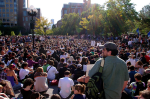
One is that we can learn from the experience of running protest assemblies. The Occupy movement and the Spanish Indignados, only mentioned for a few pages, gathered in assemblies to make decisions. Influenced by anarchism, they typically required unanimity or at least a very wide majority to make decisions. Although these movements didn’t achieve their goals, it is worth noting that unlike many others in this book, they at least managed to stay on message.
Bevins obviously cares little for Occupy’s assemblies, noting how John Lewis, a veteran Civil Rights Movement leader, was blocked from speaking at their protest because two protestors vetoed it. Surely the burden of forming consensus should have been on those wanting to prevent him speaking there? While an assembly should strive for a wide consensus, unanimity is too much, and it is better to allow a simple majority as a fallback option.
It’s also worth noting is that the media didn’t pay much attention to the protest assemblies. They may have got an occasional article such as this one in the New Statesman, but as curiosities. After all, these assemblies only represented the protestors, whose views and demographics were quite different to the country as a whole. Assemblies can only have an impact when they are representative of the population and feature a full spectrum of political views, and they can only really do this either if they’re randomly selected or open to residents of a relatively small area, such as a neighbourhood or town.
The implication that protest movements need vertical movements is also important. It raises the question: why couldn’t existing organisations do that? This includes trade unions and NGOs, but political parties should’ve been central. Instead, the usual picture was that right-wing parties didn’t support their goals, centre left ones were locked in a Byzantine-style cycle of decline, while radical left ones hardly ever became a viable force. I don’t think this is simply a case of not enough protestors trying to set up parties.
I’m convinced the real problem is that the party systems are unfit for purpose. I still advocate voting for the best (or least worst) one and I understand why they exist. If we got rid of them tomorrow, it would impossible to pass something as routine as a budget. But parties no longer represent what voters want, if they ever did. Bevins cites research on British politics, noting it could apply to Brazil:
In recent years, it has been trivially easy to find people saying that “all politicians are the same,” and then quickly follow up with the contradictory statement that “they need to stop fighting and get things done.”
I’ve thought long and hard on how we can save democracy from its current decline, and I believe the answer is to use citizens’ assemblies and people’s assemblies to resolve the burning issues of the day, which elected assemblies then act on. Perhaps parties would still have a role, but more as loose banners than the centralised organisations of today.
To make this happen, we need to create assemblies. Assemblies also need wider organisations, presumably national, to coordinate local work and host them at higher levels, such as Assemble here in the UK. Perhaps then we can create something that is, to quote a book by an activist that Bevins interviews, “Neither Vertical nor Horizontal“, a best of both worlds. Because while we’re in dire need of vertical movements, we also need the aspects of the horizontal ones that are now far better at inspiring and mobilising the masses.
So if you agree with Bevins, I advise against starting a communist party. Start a people’s assembly.




 Assembly Project
Leave a reply to A movement is stirring — my experience at Rev21’s first convention – Assembly Project Cancel reply