A small but growing movement is calling to revitalise democracy with assemblies of ordinary people, which could be springboards for campaigns and perhaps election candidates too. That might just be happening now in Serbia.

Crowds in Belgrade last December
Serbia is the largest of seven present-day states that were part of Yugoslavia in the 20th century. With the latter’s violent break-up in the 1990s, Serbia was effectively left as a country on its own after the others seceded one by one. Whereas most of Eastern Europe aspired to join NATO, Serbia ended up being bombed by them. This happened amid a series of wars when the government of Slobodan Milošević fought to keep as many Serbs as possible under a Serb-dominated government, a goal which clashed with the goals of other Yugoslav nations that fought for independence.
Serbia was one of the just two countries in Europe where the fall of communism could be portrayed as a national defeat instead of a national liberation — the other being Russia. The wars left dangerous conditions that could have led to continued instability in the 2000s. But when a revolution ousted Milošević in 2000, Serbia instead became one of the last countries to join Eastern Europe’s wave of democratisation. The now-balkanised Yugoslavia quietened down and began to recover from the traumas of war.
Serbia’s recent politics have many parallels with the better-known example of illiberal democracy in neighbouring Hungary. In the early 2010s, a nationalist conservative party came to power, in this case the Serbian Progressive Party (SNS), led since 2017 by President Aleksandar Vučić. The years since have seen not an overt coup but a gradual democratic backslide, with the party maintaining power with a mix of corruption, conservatism and occasional coercion.
In 2019, Freedom House downgraded Serbia from “Free” to “Partly Free”. Press freedom, academic freedom and numerous other democratic rights have been eroded. One reason for the lack of international attention is that the geopolitical effects have so far been minor; Vučić has courted the EU, other Western countries, Russia and China. One bright spot of the SNS era has been Serbia’s rapprochement with Kosovo.

Aleksandar Vučić, President of Serbia since 2017, having previously been one of the most powerful figures in the government for five years before.
Since last November, a protest movement against the government has simmered. It started with a disaster on 1 November in Novi Sad, Serbia’s second-largest city. A newly-built canopy collapsed at a railway station, killing 16. It was blamed on shoddy construction by corrupt contractors. It triggered student protests that spread across the country within weeks.
There have been a few similar protest movements in Serbia in the last eight years which, like most recent protest movements, failed to make a dent. When this wave proved stronger, the government responded partly with concessions, including firing Vučić’s official deputy, and partly with crackdowns, including an alleged use of a sound weapon and other cases of violence. They have also relied on support from the more conservative and nationalist voters who, in the current polarised climate, can easily be led to disdain a student protest movement. So despite the size of the protest movements, this backbone of support for the SNS did not immediately give way.
Perhaps in response to this deadlock, the Serbian movement has taken an interesting turn. They began to organise local people’s assemblies, referred to by the word zbor (“gathering, meeting”). It was bringing the plenum assemblies students had organised among themselves to the wider public.
In one report, Balkan Insight offers a firsthand account of taking part in a zbor composed in this case of parents at a school:
To a certain extent, it was plenum-like: the group provided daily updates about the citizen protests and school issues, especially the teachers’ strike; we could vote on certain proposals online, but there was no formal plenum process as in the case of student plenums; the group organised different actions to encourage the teachers from our school to radicalise their strike, and gathered in front of the school gates for a symbolic ‘coffee’ to demand classes be cut to 30 minutes from 45 as another form of protest.
At first, the group was ignored by the school principal, but later it was acknowledged as an informal voice of parents.
Coverage in Deutsche Welle notes how the assemblies are open to “anyone who wants to participate” and quote an organiser who says:
The government has been trying to infiltrate them from the beginning, but as long as they make decisions collectively, those infiltrators have no influence. Additionally, they have no leaders, so the government has no one to bribe or publicly discredit.
While this shows the advantages of the movement’s decentralisation, there remains the question as to whether the movement can withstand the challenges ahead when it is organised at a local level but not at a national one. A lack of organisation is the problem that, as the journalist Vincent Bevins notes, has been the undoing of many recent protest movements.
So far, the zbor assemblies have had small, localised successes. But could they and the movement they’re part of muster the kind of support needed to revitalise Serbia’s democracy?
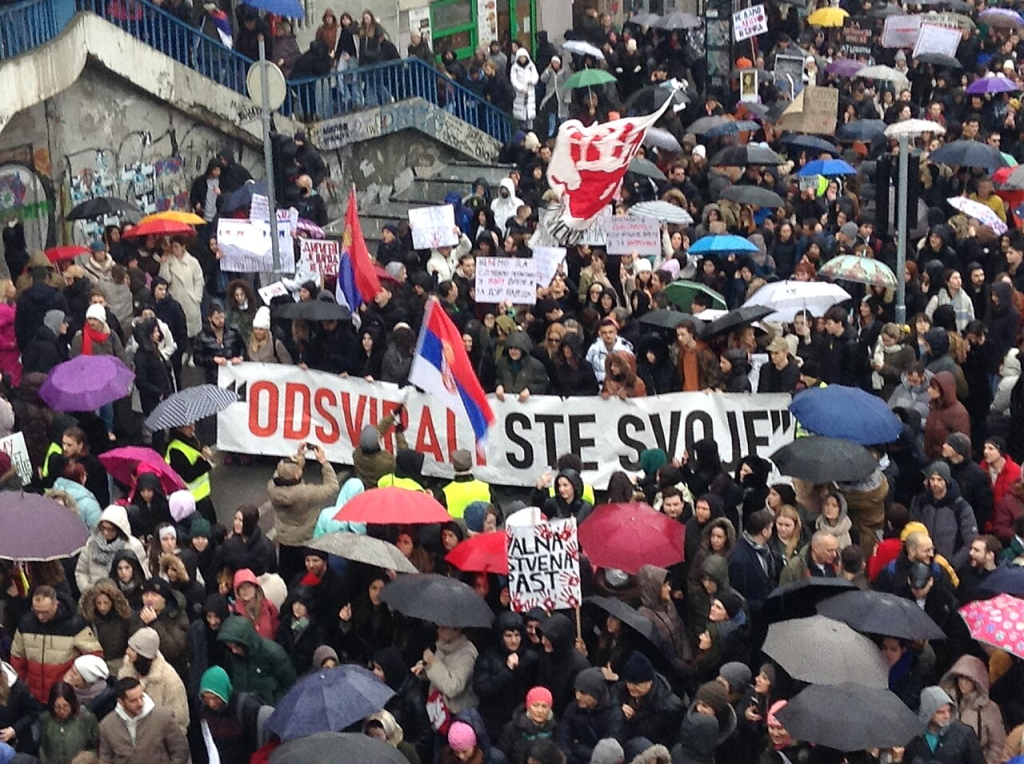
One of the Serbian protests last January. The sign says “You have finished playing your melody”, a figure of speech for “You’re time is up”.
The first test came last weekend, when Serbia saw its first local elections since the protest movement began. In two municipalities that had been strongholds for their support, the SNS hung on to control of both the councils but with losses, winning the smallest possible majorities over united lists of opposition candidates. It suggests that support for the SNS has, though not disintegrated, nonetheless fallen. But the logistics of running a national election campaign would be a much bigger challenge.
It is too early to predict what will happen next, but I suspect that the assemblies in Serbia are a sign of things to come in other countries.





Leave a comment