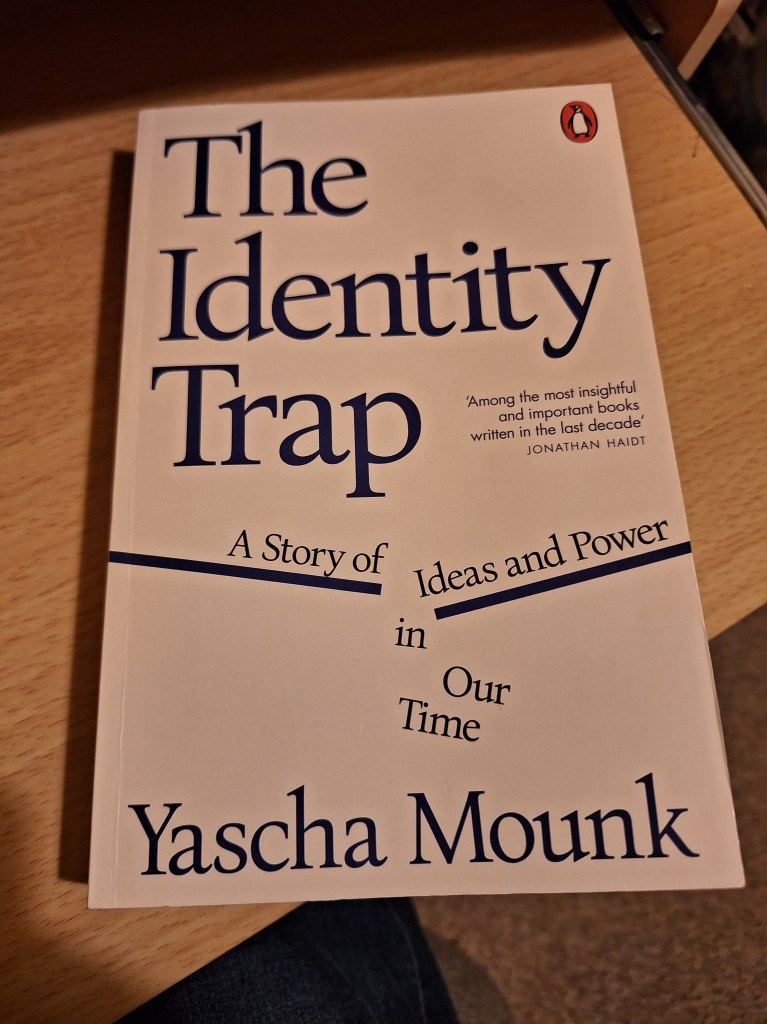
In the Western world and especially the United States, the political left has a problem. It is increasingly seen as a champion of the identity politics of discriminated groups to the exclusion of others, sometimes rightly and often wrongly.
Yascha Mounk had previously written books such as The People vs. Democracy: Why Our Freedom Is in Danger and How to Save It (2018) and The Great Experiment: Why Diverse Democracies Fall Apart and How They Can Endure (2022). Whereas these were prescient warnings of the growing danger the far right posed to democracy, in The Identity Trap (2023) he turns his attention to the illiberal identitarian currents of the left.
I have seen this referred to by many words, most often woke, which Mounk avoids, saying he would sound “like an old man yelling at the clouds”. It is also called identity politics, though the latter can more broadly include right-wing identity obsessions such as nationalism. It has also been called illiberal multiculturalism, left illiberalism and left identitarianism. Proponents offer no word for it, leading Mounk to call it “The ideology that dare not speak its name”. He opts to call it the identity synthesis.
This book is a clear, well-reasoned argument for universal liberal values – liberal not in the partisan sense, but in the broad sense of supporting the values of liberal democracy. It comes from the intentions of wanting to create a more equal society, free of discrimination, and Mounk acknowledges that many figures who have created and promoted the identity had similarly good intentions. It does, however, start on a shaky note that sometimes returns later on, as Mounk bends over backwards to portray the identity synthesis as a bigger attack on liberal values than it really is.
A problem, but how much of one?
The book opens with the story of a school in Atlanta that appears to have racially segregated its classes, believing this would benefit its Black students. Mounk describes it as “part of a new ideological trend”. But this story made headlines, like most things that do, precisely because it wasn’t normal. Mounk also cites it as influencing a US government agency to recommend a higher priority to key workers for Covid vaccinations, whereas other Western countries prioritised the more vulnerable elderly. As he admits, the agency backed down after public criticism.
There have been many stories like these, and I’d be surprised if there hasn’t been an uptick in those incidents. But, as Ben Goldacre said, “the plural of anecdote is not data”. By contrast, as Mounk indeed notes, many countries like the US have indeed seen a rise in attacks on free speech, such as book bans and anti-protest laws, but they come from the right, not the left.
Indeed, the one piece of data cited that actually does suggest a widespread and worrying impact is a piece of polling that found that “More than three out of five Americans now say that they abstain from expressing their political views for fear of suffering significant adverse consequences.” That suggests it’s not so much a problem with political correctness gone mad as a problem with a perception of political correctness gone mad.
To me, that speaks volumes of how the media, both traditional and social, has blown the threat out of proportion, albeit only because they needed those views and clicks. It also reflects a failure of the left to champion the value of free speech. Whereas the right are failing to practice what they preach, the left are failing to preach what they practice.
I agree with Mounk that identity illiberalism is deeply flawed, just that I would emphasise different reasons. There are quite a lot of problems that could be explored. One is how framing your campaign as benefiting an outgroup can alienate people who would agree with its aims. For example, in polls like this one in 2017, clear majorities of Americans agree there are problems with racial bias in policing but far fewer support Black Lives Matter, who were founded to address that very problem. Moreover, even when identity illiberalism costs people their jobs, it’s almost always someone from a discriminated group or the left. A demagogue won’t lose his job to political correctness gone mad, but a lesbian professor might.
And there are a few others that Mounk touches on. One is its failure to win or even demand things from the elites with a material impact on people’s lives, instead of token hirings and symbolic gestures. And as this article notes, it has also led to many progressive organisations being neutered by infighting. (“It’s hard to find a Washington-based progressive organization that hasn’t been in tumult.”) He also notes how “right-wing populism and the identity trap feed on each other”. It reminded me of a quote from L. L. Zamenhof, a Polish Jew who invented the Esperanto language because he wanted to bring people together:
It is true that the nationalism of oppressed peoples – as a natural defensive reaction – is much more excusable than the nationalism of oppressing peoples; but, if the nationalism of the strong is ignoble, the nationalism of the weak is imprudent; both give birth to and support each other…
The ideology that dare not speak its name
I have little dispute with what else he has to say. In the first half of the book, he offers a history of the identity synthesis. Far from being “cultural Marxism” as some claim, Mounk points its origins to the rejection of Marxism, as well as universal values and “grand narratives”, by early postmodern figures like Michel Foucault. Except that Foucault saw identity labels as oppressive creations of society. Mounk documents how successive thinkers like Edward Said, Gayatri Chakrovorty Spivak and Kimberlé Crenshaw, drew on Foucault’s cynicism while turning the rejection of identity on its head:
They continued to wield the tools of postmodernism to cast doubt on any claims invoking scientific objectivity or universal principles. At the same time, they insisted that they can speak on behalf of groups of oppressed people by invoking the tactical need for what they came to call “strategic essentialism.” This attempt to square the circle is still apparent today when activists preface their remarks by acknowledging that race (or gender or ability status) “is a social construct,” before going on to make surprisingly essentializing claims about what “Black and brown people” (or women or the disabled) believe.
This is then followed by documenting its journey from obscure academic debate into the cultural mainstream, starting first with the forgotten social media site Tumblr, continuing onto alternative media sites like Vox, and finally the mainstream press.
While the identity synthesis does appear to have been gaining traction beforehand, what comes across loud and clear is that the rise of Donald Trump turbo-charged its rise in the United States. Many on the left became unable or unwilling to say “No” to it, and Mounk discusses how findings from psychological experiments explain why. In other countries where the stakes of politics weren’t as high, its rise was more muted.
What was the reason for this long-term rise? Was it also a reaction to existing politics? In the US that is plausible. The Republican Party wasn’t exactly promoting social harmony before it was taken over by Trump. But that can’t explain why similar trends were reported in other countries like the UK.
I cannot offer data, by my view is that we need to consider the Bowling Alone hypothesis. Since the mid-20th century, there has been a gradual rise of loneliness in rich countries, driven partly by new technology like television and computers. When people have less face-to-face groups to belong to, they are more likely to seek belonging somewhere else, whether a nation or an identity group.
A case for free speech
Most of the remainder of the book is concerned with criticising the identity synthesis and what it claims. In addition to the points discussed earlier, he argues that it had led to the demonisation of healthy cultural exchange as cultural appropriation, and offers a more detailed case for free speech.
Some on the left have become wary of free speech, no doubt because some of their enemies have exploited it in order to spread insults, threats and dangerous misinformation. But as Mounk notes, free speech helps discriminated groups. They are often the ones who need to point out something that’s wrong with the status quo. And if you restrict the right to free speech, who will police it? A relatively powerful subset of the population, of course.
When faced with threats and misinformation from the far right, it may be tempting to demand that governments and other power players like social media sites get tough on them. While there have to be some limits (e.g. libel and fraud laws, moderation of internet forums), they are not the ultimate solution. Using these tools against the far right can even backfire. When the Dutch demagogue Geert Wilders was prosecuted for hate speech in 2016, his party surged in the polls. Far better would be to get tough on the causes of the far right, by finding new ways of doing democracy in our communities so people can feel less powerless and more connected to others.
I’m largely in agreement with his criticisms, though I think he also overlooks the argument that racial inequality can be structural or systemic – in the air rather than the work of bad people. Also missing is the issue of the meaning of words, with a prime example being racism. Wikipedia and many dictionaries define it as a “belief” in some form of racial superiority, a belief that few in the Western world have had for decades. But many key figures of the identity synthesis like Robin DiAngelo and Ibram X. Kendi have used it far more loosely, not just for racial discrimination, but also racial inequality. These things are not the same.
Rediscovering the Enlightenment
Mounk argues the identity synthesis has three core beliefs:
- The key to understanding the world is to examine it through the prism of group identities like race, gender, and sexual orientation.
- Supposedly universal values and neutral rules merely serve to obscure the ways in which privileged groups dominate those that are marginalized.
- To build a just world, we must adopt norms and laws that explicitly make the way the state treats each citizen—and how citizens treat each other—depend on the identity group to which they belong.
And he instead proposes three alternatives:
- To understand the world, we must pay attention to a broad set of categories, including—but not limited to—forms of group identity like race, gender, and sexual orientation.
- In practice, universal values and neutral rules do often exclude people in unjust ways. But an aspiration for societies to live up to the standards they profess can allow them to make genuine progress in treating their members fairly.
- To build a more just world, societies should strive to live up to their universalist aspirations instead of abandoning them.
Mounk winds down the book by explaining the best arguments for more universal values. So why don’t more people get on board?
Perhaps they will. Perhaps the identity synthesis will turn out to be a fad, and the more enduring Enlightenment values will outlast it. But while they are a strong, longstanding tradition, such traditions can be eroded, as has happened with Christianity in the Western world. We cannot assume these values can be sustained just because they’re a longstanding tradition. This is true for other liberal traditions such as the constitution of the United States.
The solution is to make sure that people can discover Enlightenment values for themselves, on their own terms, since they are mostly common sense. If you had to design a society from scratch that you would live in, you probably want it to have free speech, freedom of religion, equality before the law and so on. Partly to allow people to discover that, we also need to have more face-to-face democracy in our lives.
Unexpected tips on assembly democracy
I wasn’t expecting this book to relate much to my project to start a people’s assembly, but this book inadvertently pointed to some useful findings from psychology.
I’ve been sceptical to the concept of groupthink. My opinion has been that the more people discuss an issue, and the more variety of backgrounds, personalities and experiences they bring, the more likely that they will reach the best possible solution – as long as they know what they’re talking about. This is partly due to the chance of that solution being mentioned in the first place, and because of the benefits of having many take part in the judgement.
Yet there’s evidence that under some conditions, groups can cause people to act irrationally. The obvious one is the Asch experiment on conformity, in which peer pressure can make people give out glaringly wrong answers. Mounk also cites some fascinating evidence of an experiment in which a group of people have to decide how much compensation a company must pay if its negligence injures a small child:
In the experiment, each member of the group privately recorded what sum they deemed appropriate, with suggestions ranging from $500,000 to $2 million. What sum did they agree on after they had a chance to discuss the issue as a group? […] In most cases, groups deliberating on damages in such a situation awarded a much higher penalty—as high as $5 million or $10 million.
This is important to think about when running an assembly. As Mounk says, sometimes it might actually be right for a group to discover a radical solution through their debates, but not if it’s merely due to peer pressure. How do you solve the problem? Two researchers have an answer:
Internal criticism and dissent are vital for social groups’ success […] They prevent group members from insulating themselves against viewpoints that could be crucial to group decision making. They also prevent groupthink, the process by which members of a group overemphasize similar opinions and shut down dissenters.
This won’t happen if a group becomes hostile to dissent from its members, setting itself on a path towards either falling apart or radicalising. Mounk notes two factors that can cause this: “powerlessness” in the face of high “moral stakes”. This is certainly true for left-wing groups if the far right comes to power and there is no clear way to dislodge them. This explains why American progressive groups became beset by this problem not so much during the first year of Trump’s first presidency, but as it continued.
If you start a people’s assembly in your local area, you can’t control the stakes, but hopefully you won’t end up powerless. This is a matter of setting realistic expectations. On the one hand, if you set people up to believe that your assembly will rapidly lead to a revolution, you will look powerless if it doesn’t happen. On the other hand, you will also look powerless if you don’t offer at least some hope that the assembly will be able to accomplish something. Overall, it is better to float expectations without saying something will happen for sure, but focus more on more local goals.






Leave a comment