Why am I so prone to bending covers?
As the former CEO of Oxfam, the venerable charity for global poverty relief, Danny Sriskandarajah has met with many well-known figures. Among them was Prince Philip:
As I began to reply that I had been drawn to an association built on shared values like democracy, Prince Philip quickly interrupted me. ‘Is it?!’ he challenged. He went on to give an unexpected, but rather eloquent, explanation of how many countries claim to be democratic, but never take citizens seriously.
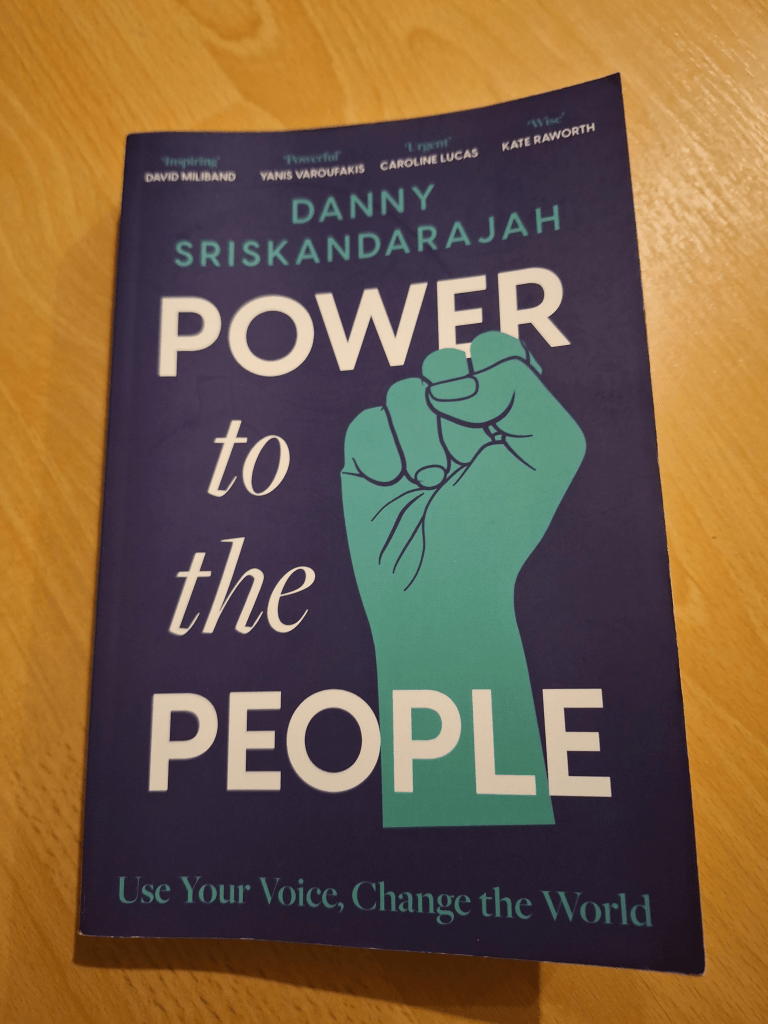
The royals can surprise us, can’t they? I think of how Prince (now King) Charles championed a people-centred approach to architecture. Sriskandarajah, whose work has taken him to places like the United Nations, also comes across as attuned to the wider public’s needs, as well as willing to critique the culture of big NGOs that he’s been part of. In Power to the People (2024), he offers an inspiring, accessible discussion how to give exactly that, to make the 21st century “the Century of the Citizen”.
It has not got off to a promising start. He moves on to the depressingly familiar story of democracy in recent years, not one of brazen coups but of slow backslides, not just in poorer, vulnerable democracies but also in many rich, mature ones like the UK. It has also been marked by declining civil liberties, failed protest movements, self-serving media and the growing and dangerous power of Big Tech monopolies and other wealthy elites.
What’s on point here is that he highlights a “crisis of imagination”. Part of the problem is that we want the system to be more democratic, but we don’t know how, because we still can’t move beyond the idea of ‘democracy = elections’. In the early 20th century, it was obvious what more democratisation meant — giving women and more men the right to vote. But although citizens’ assemblies have widespread academic support and are liked by voters who’ve heard of them, they don’t have that kind of visibility.
Sriskandarajah discusses four routes to democratisation:
- Reimagining democracy
- Democratizing the economy
- Finding our global voice
- Securing our digital future
It is the first one that is most relevant to this blog.
Citizens assemble!
In the first chapter, Sriskandarajah notes further that we have:
…a system that is crippled by its dependence on the campaigning, party-standoff mindset in which complex ideas and critical thinking are reduced to three-word slogans and whatever clear dividing lines can be unearthed or, if need be, fabricated. Filtered through the lens of media outlets whose survival depends on their ability to entertain and, often, arouse division, much of today’s political debate is forced into unhelpfully moralistic narratives. Politicians are encouraged to focus on disparaging the policies and motives of their political opponents and on feeding the media’ addiction to contempt and resentment.
Some of these problems are nothing new. Divisive media certainly isn’t; look at the Daily Mail publishing the Zinoviev letter hoax in 1924 or the Chicago Tribune calling Harry Truman a “nincompoop” in 1948. (Truman soon got his revenge.) One question we must ask is why these forces of division are undermining democracies that could withstand them in the past. My view is that the internet age has made us more exposed to the failings and scrappings of politics.
In response, he cautions against referenda, and shows more faith in citizens’ assemblies. For the UK, he suggests replacing the House of Lords with a citizens’ assembly called a House of the People, a proposal that has now been championed by Assemble.
However, he notes that citizens’ assemblies have limits. In 2019, the government of Emmanuel Macron organised a citizens’ assembly on climate, a fascinating exercise that came up with some excellent proposals. But most of them weren’t implemented by a cautious and distracted government. I have to wonder too whether they were afraid of what would happen if they passed a proposal that the wider public weren’t sold on.
There remains a question mark on how to navigate this with citizens’ assemblies. It stems from a problem called Fishkin’s trilemma. As a trilemma, or impossible triangle, there are three desirable things, but having two cancels out the third:
- Participation: You want as many people as possible
- Equality: You want everyone to be treated equally.
- Deliberation: You want good quality deliberation, in which people listen to each other and share their views.
In practice, no process can have all three, unless you could persuade the entire electorate to sit down and deliberate. Voting allows for high participation and equality, but don’t give people much of a chance to deliberate. So how do you get around this?
Most likely, we will need to use several processes, so that the flaws in each process are countered by the strengths of others. One idea is to accompany the assembly with wider participation events like local people’s assemblies, which don’t have the same legitimacy but encourage a wider number of people to see where the citizens’ assembly is coming from.
Liquefy or try AI
Sriskandarajah also discusses the concept of liquid democracy. This is a concept that involves using digital platforms. It aims to:
…liquefying the rigid structures of representative democracy and creating a greater number of more flexible participation opportunities for citizens, [so] we can infuse a rapidly stultifying framework with the life-giving energy of direct democracy.
An important part of the concept is making the participation fun using techniques like gamification. An example of the latter is Duolingo, the popular app for learning languages, which uses a game-style system of rewards to encourage users to keep plugging away at their learning. He discusses how governments in Spain and Estonia have created new online platforms for allowing people to communicate their needs to the government.
In practice, I’ve seen too many unexpected consequences when online platforms have become infested with politics, largely because they don’t have the sociality of real life. I am likewise sceptical about electronic voting, given that electronic systems are at risk of a myriad of problems like hackers, viruses and bugs.
More promise is found in his discussion on AI, a subject he returns to in a later chapter. While it creates some obvious threats, such as allowing video deepfakes and other ways to create hoaxes, it also offers unprecedented ways to democratise, such as producing summaries of people’s suggestions. This has been seen with some groups like Assemble and the Humanity Project that have tried Dembrane (mentions in this Assemble press release). While this deals with summarising discussion in a room, it could also be used over a much wider area. I will be doing some more posts on AI in the future, because a discussion on the future of democracy (or anything) would not be complete without it.
Civil society
Though I’d have liked to see it engage with Kate Raworth’s Doughnut Economics, the section on the economy has interesting ideas, even encouraging us to look at new ideas about currency. The next chapter looks at international organisations. The ‘vetocracy’ of the UN has left it unable to be anything more than a forum for dialogue which, while useful, means it has never had the sort of moral authority its founders hoped for. You get the idea that a global citizens’ assembly would be a good thing too, even if it doesn’t gain authority straight away.
If it wasn’t for this blog’s focus on assembly democracy, there is much else that can be discussed in detail. But I want to go back to something Sriskandarajah introduces early in the book — the concept of civil society.
Often a difficult concept to pin down, it is also often thought of as a parade of NGOs. But civil society isn’t just about Oxfam, Rotary, churches, community centres and the National Trust. During the pandemic, many efforts were done by individuals or even for-profit businesses to aid those in need. They reflected a deep interconnectedness that can be hard to measure or see, which he likens to the amazing networks that develop among fungi in forests.
Later on, he returns to the theme. The trouble with civil society is that it must grow organically; it cannot be created from the top down. As he mentions, David Cameron’s vision of “Big Society” never advanced beyond being a vision. (His government’s austerity program didn’t help either.) How can we make it grow, and grow into something better? That may take a shift in thinking and expectations but, in relating the story of Oxfam’s founding, he reminds us that has been done before.
It will also take what More in Common refers to as the “civic pragmatists“. They’re the kind of people who might be drawn to running projects and organisations in their communities but are turned off by the rough-and-tumble of politics. They lean left overall, but care more for practical solutions than any tribal or ideological cause; there are conservative parish councillors who may well fit that description. They tend to be well-to-do with compassion for the worse-off, though they may not always understand them. They provide ballast and bonding in a healthy political scene, and are easily driven away from an unhealthy one.
This is not a book you’d read for concrete suggestions on how to give power to the people, even when he touches on worthy examples, a few familiar and others less so. It is more aimed at inspiring you and broadening your mind, and his final message is to encourage you to go out and pursue the change you want to bring.
I’ll try my best, mate.





Leave a comment