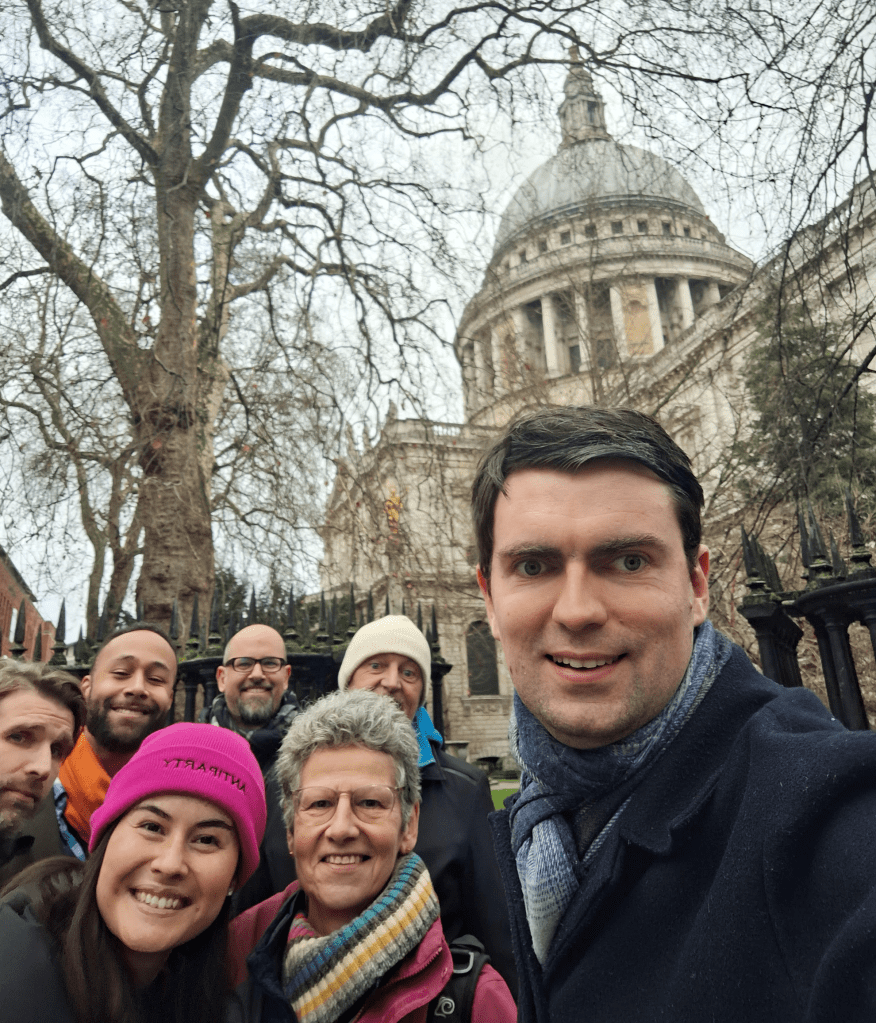
A few weekends ago, I went on a walking tour of central with Bella Roberts from Antiparty, a group dedicated to envisioning democracy without the party system of today – something I have independently concluded myself. They are particularly interested in sortition, deliberative democracy and giving power to local communities. As they put it:
We will restore hope by re-imagining a system that works for us, not those in power. Through a combination of art and creativity, experience and expertise, we seek to inspire new solutions to old problems.
I love exploring cities with a walking tour, especially one with a theme. This one was themed around the radicals rebels of the past, from Boudicca to the Levellers to the Battle of Cable Street. It was quite interesting how some linked to each other; Bella told us about the Quakers. Later, we learned about the Poplar Rates Rebellion, whose leader George Lansbury was also a Quaker. We walked on foot from Westminster to the Square Mile and into the East End.
Bella was a great guide, telling us stories on the way, and our walk was a valuable opportunity to speak with several others who shared my interest in assembly democracy.
The West End: Revolution
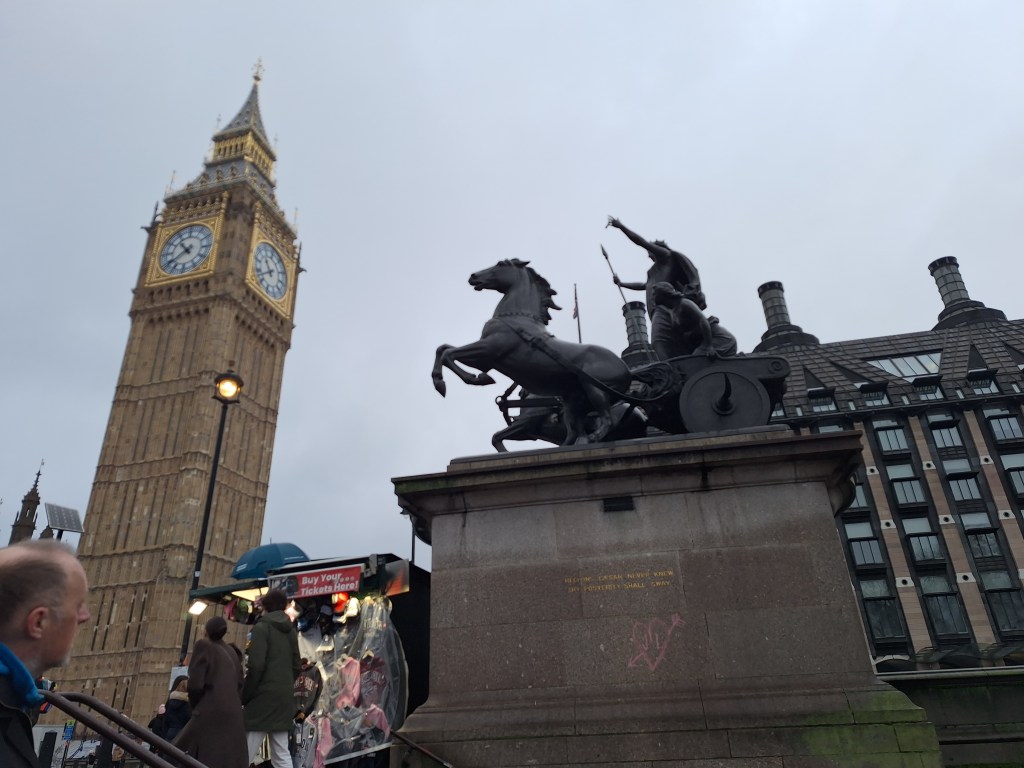
I didn’t know there was a statue of Boudicca here in such an iconic location.
We started in Parliament Square by a large statue close to Big Ben (now officially called the Elizabeth Tower). I had seen it before but didn’t know it was Boudicca. It was raining at first, but thankfully stayed dry for nearly all the rest of the day. Bella then led us across the Parliament Square to tell us about the English Civil War, or as I prefer to call it, the English Revolution.
I remember a question popped up on Quora once about why France had a revolution but Britain didn’t. As many answers pointed out, they had two revolutions in the previous century, including one where a king was also beheaded. We’ve just been very good at concealing it and making our monarchy look like an unbroken tradition.
The English Revolution is one of my favourite periods of history to study. It marked one of the world’s first democratic struggles, yet fit squarely into Early Modern Europe’s religious wars. Like France and Russia, it’s a cautionary tale about how revolutions can unleash the most unexpected forces, and it produced great events but no Great Men. And it led for a brief moment to the flourishing of some radical movements like the Diggers and Quakers.
Bella focused on the Levellers, so-called because they wanted to make society more equal, or level. This included freedom of religion and the right to vote for nearly all men. They were also innovative campaigners, with their use of petitions, pamphlets and a pioneering mass newspaper. No wonder that in 1988, a folk punk band wanting to evoke both radicalism and English heritage chose Levellers as their name.
It was a movement truly ahead of its time. And yet, they were also of their time; the actions of the Leveller mutineers made more sense back then than they would now. And even the Levellers couldn’t foresee votes for women.
My theory is that we are in the run-up to a new revolution, which will bring forward the idea of radically remaking democracy with innovations like citizens’ assemblies. This phase is often marked by “the Squeeze”, a period when reactionary forces gain the upper hand. We see this in Charles I’s eleven years ruling without Parliament. Two centuries later, the Peterloo Massacre and the Six Acts repressed the campaign to democratise Parliament, until their aims came true in the Great Reform Act. In America, repression also preceded revolution. In France, the period when the nobility blocked Louis XVI’s attempts to tax them and later the reign of Charles X.
Our current Squeeze has marked by a decline in civil liberties, Brexit, flag-waving, waves of hate crime, rising record support for the far right and the scapegoating of foreigners and minorities. In Britain, a notionally centre left government restricts the right to protest and plans to curtail jury trials. Compared to America, led by what one guy called “the Squeezer-in-chief”, we’ve got off lightly.
Designing a virus
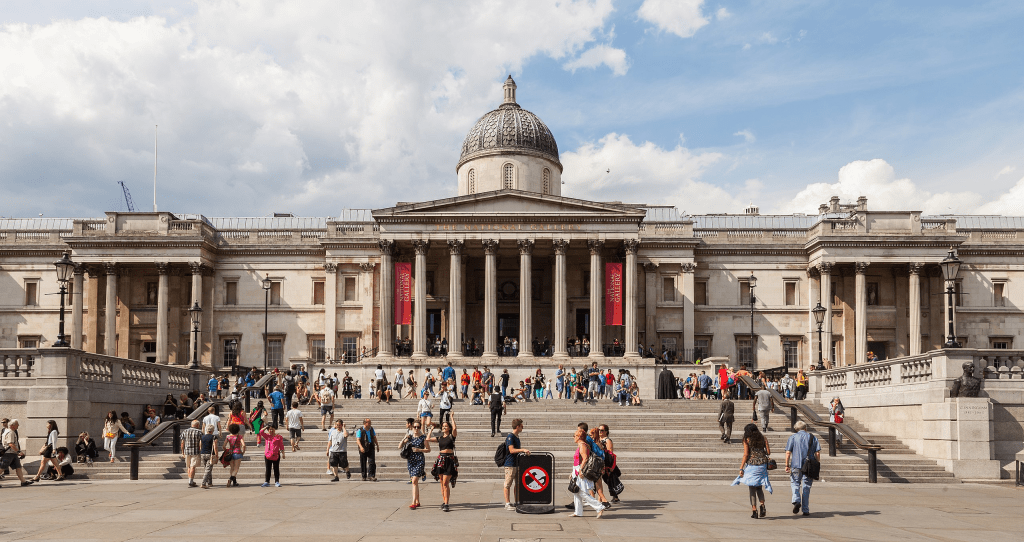
The National Gallery building on Trafalgar Square
But there are also encouraging signs beneath the surface that assembly democracy is taking root. One surprise stop was the National Gallery. There was much discussion here about citizens’ assemblies: how can you encourage citizens’ assemblies, and how can you turn their decisions into action?
Ireland has provided the most famous example of how a citizens’ assembly can aid a democracy, when it led to the legalisation of abortion in 2018. This is an example of a top-down approach to spreading citizens’ assemblies, using them to solve problems facing politicians.
I think we need more than top-down approaches. Britain has now had several governments in a row becoming deeply unpopular, but unlike their Irish counterparts, none have shown any interest in these kind of democratic innovations. The Irish government’s interest in citizens’ assemblies were met with a setback in 2024 when an attempt to remove outdated language around women from the Constitution failed by a 2/3 margin. There seem to have been several problems: the citizens’ assembly hadn’t been presented with counterarguments and the government didn’t follow its recommendation directly.
Much of our conversation was about asking how we could spread deliberative democracy at a grassroots level. I was able to talk about my work with Assemble, such as the one I facilitated at in Brixton. They are hoping they can design a format for assemblies that will spread organically from neighbourhood to neighbourhood— exactly like a virus! But they don’t just have to be for neighbourhoods too.
And this is where the National Gallery comes in. It’s one of several British museums that has lately employed a citizens’ assembly for advice on its direction. It’s a brilliant idea. In particular, museums can use them to settle the thorny culture war disputes that have popped up in recent years, and to address questions like when to display Renaissance portraits versus modern art. (The National Gallery has very few paintings from after 1900.) When organisations like museums start making use of them, concepts like deliberative democracy and sortition can spread more widely.
AI (Awkward Issue)
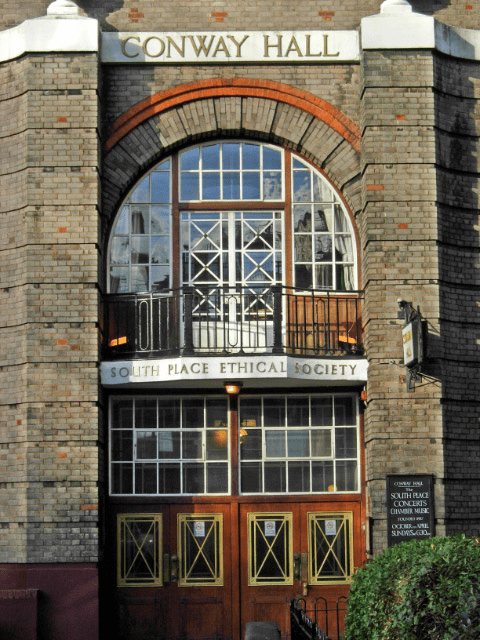
Conway Hall, home of the Ethical Society, now a branch of Humanists UK
One guy was especially keen to discuss the future impact of AI – by which we generally mean the recent Large Language Model (LLM) breakthroughs that have made chatbots like ChatGPT, Gemini and Copilot possible. This a subject I intend to do a post of my own in the future, having read a few books on the matter. It stirred a series of lively debates between those of us who were soft pessimists who fear its impact on jobs and democracy and soft optimists who downplay those fears and emphasise that it will bring benefits too.
An example of the latter is that Assemble used Dembrane as part of their House of the People assembly last year — another stop was Conway Hall, the venue where it took place. Tools like Dembrane could be used to transcribe assembly discussions and gauge the prevailing views of those present. Apparently, AI apps can automate the role of a discussion facilitator. I would prefer to keep human facilitators, both as a safeguard against technical blunders and to give the assembly a human touch, but an AI app could help them do their job better. (e.g. “You haven’t asked Sayeeda for her opinion yet.”)
Moreover, AI will make further democratisation of knowledge possible. Until now, running an election campaign required connections and know-how that were accessible only to a few of the political elites, one reason why most Western countries were dominated by the same parties since the Second World War. Just now, I typed “What do I need to run an election campaign in the UK?” into ChatGPT, and it responded with a detailed list of all the staff I would need. Of course, you could’ve probably found that information on the internet already, but LLMs often make it quicker and easier to get information. The time will come when we can access the information in real time through something like smartglasses and later a brain-computer interface.
In the short-run, AI has been overhyped and there are clear signs it has caused stock market bubble that is about to burst. This is much like how the rise of the internet caused the dotcom bubble that burst in the early 2000s. Like the internet, AI (specifically Large Language Models, LLMs) will change things, bringing genuine improvements as well as challenges. The dominant view among experts is that it will not destroy jobs for the foreseeable future. Still, it is impossible to predict what will happen when new forms of AI emerge that overcome the limitations of LLMs.
The Square Mile: Lords of London
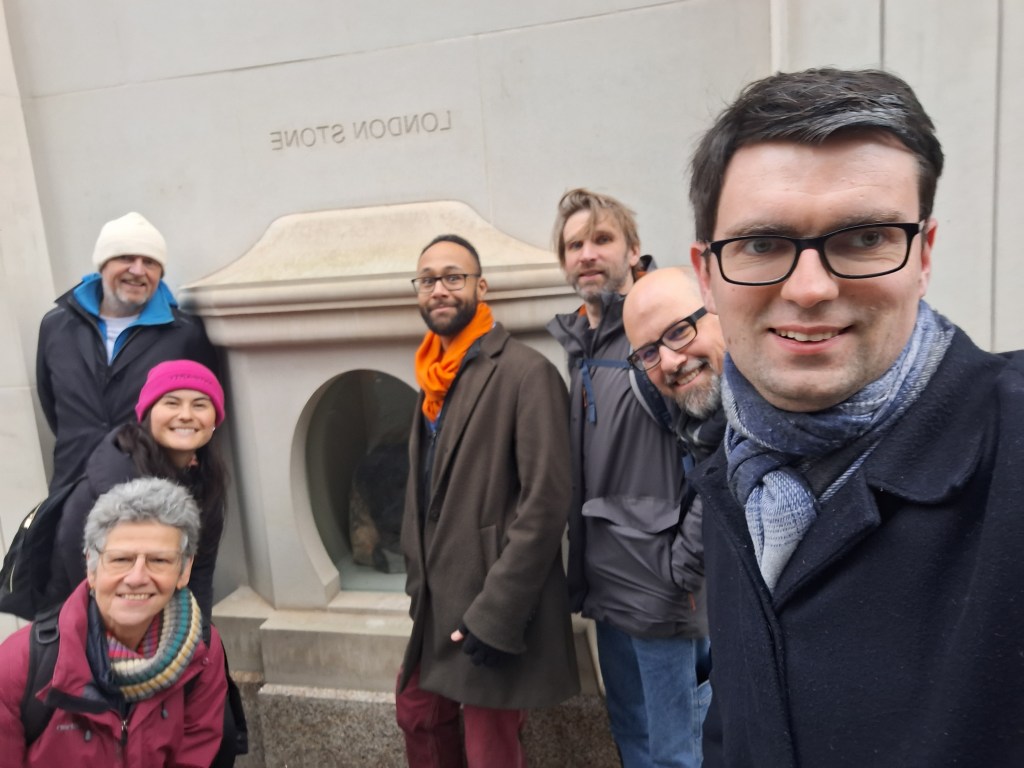
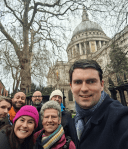
As usual, because of my height, I was taking the group selfies.
We walked on to the so-called City of London. Nowadays, when we refer to London, we refer to the wider metropolis. But the City of London, or Square Mile, is its traditional boundaries. Today, it’s mostly a financial district and despite some gems like St Paul’s Cathedral and the Gherkin building, it’s much blighted by modern planning.
One stop here was the London Stone. This block of limestone is said to be the oldest object in the city. It has been on display since the Middle Ages and has been the subject of many legends; one connected it with the city’s legendary founder King Lud. In 1450, peasant revolt leader Jack Cade stuck his sword in the stone and proclaimed himself “Lord of this city”. The stone is now on display in a glass case on Cannon Street.
It was here that Bella told us about the time she had been the lead candidate of Londependence, who stood in the 2021 London Assembly election on a platform of further devolution of powers for London. (Here is the campaign video.) Unlike most British elections but like most on the Continent, the London Assembly is elected with a proportional voting system. So although they didn’t need a high vote share to win seats, they faced the tall challenge of winning that share over such a wide electorate. Although they didn’t win any seats, she enjoyed the experience.
This is in contrast to Frome, where a coalition of independents took over the town council a mere four months after they had formed, and expanded their support over the next decade. As it was a town with a population under 30,000, it was easier to organise a movement that could rival the traditional parties. Not surprisingly, Bella and the group were well acquainted with this example.
The East End: You Shall Not Pass
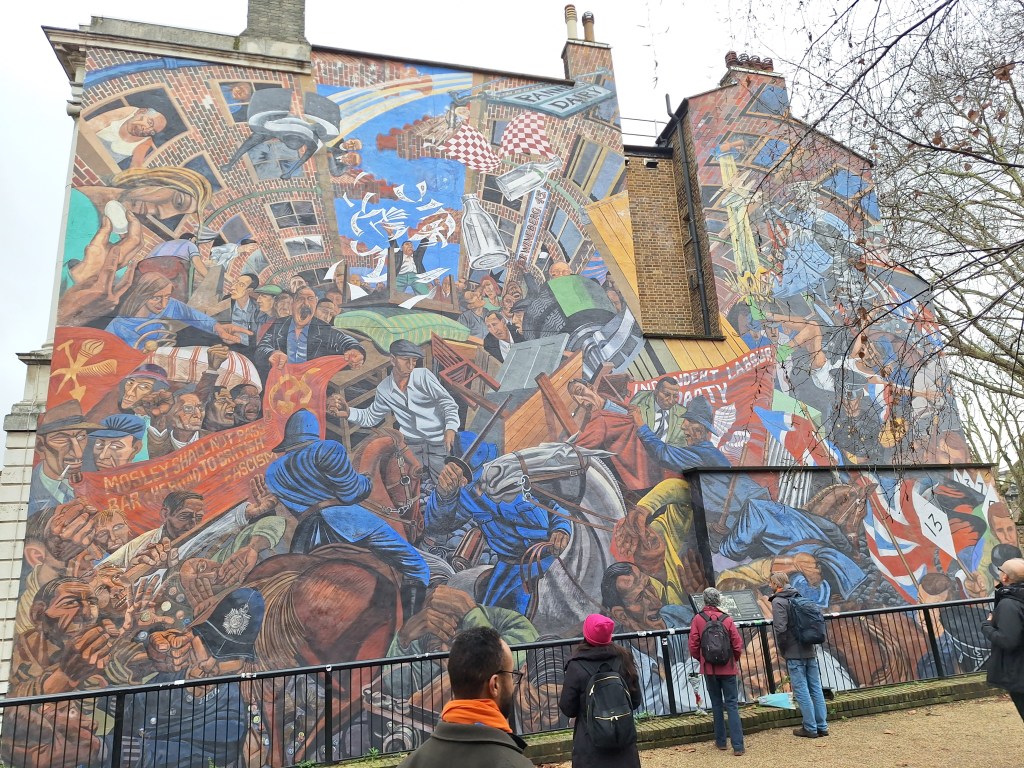
We finished our tour in the East End. One stop was the Cable Street Mural (1983) by Dave Binnington and several collaborators, commemorating the Battle of Cable Street in 1936. The mural is colourful and chaotic, commemorating a collective struggle, not any individual. Its overall message is many different plucky East-Enders uniting against symbols of power, violence and conformity.
In 1936, the British Union of Fascists (BUF), led by Oswald Moseley, tried to march through a largely Jewish neighbourhood of the East End while dressed in their blackshirt uniforms. They were met with resistance organised by several left-wing groups, including the Communist Party, Independent Labour Party and Jewish People’s Council. They mobilised East Enders of many ethnicities to block the march, and adopted “They shall not pass” as a rallying cry. They succeeded in stopping the march, in what marked the beginning of the end for the BUF. But crucially, unlike similar heroics in Germany and Italy, they had the wider political weather on their side.
Though the BUF seized the headlines in the 1930s when they caused street disorder and briefly gained support from a major national newspaper, they never had a serious chance of gaining power. Already the previous year, they were so unpopular that they hadn’t even bothered to stand in the 1935 election. I have suggested that Britain was resilient against fascism in the 1930s thanks to the strong institutions that gave people belonging and some connection to the political class. The BUF had tens of thousands of members at its peak, but it was dwarfed by the Big Two parties, the trade unions and institutions of civil society like the National Trust.
Today, despite the grim spectacles we’ve seen in the last month in America, I hope that our struggles with the far right can be less violent. Indeed, assembly democracy requires us to build bridges with those with different political views, which becomes significantly harder after episodes of violence.
Cable Street showed the value of bringing organisation to the working class. Although not without its flaws – the organisation of the 20th century focused too much on the workplace and excluded women – it helped counter not just the fascists but also the causes of fascists. We are once again in need of organising the working class, but not the usual blue-collar definition of working class. We mean those who are not in the top 1%, and including those who don’t necessarily work.
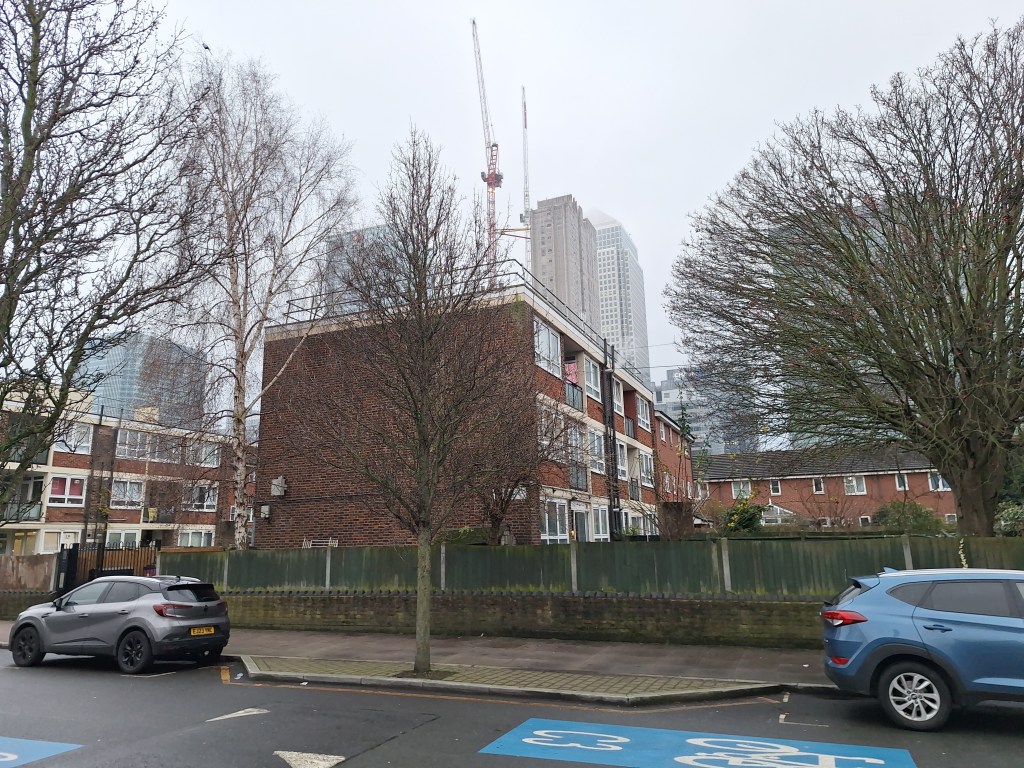
Though it remains home to some of the city’s poorest neighbourhoods, the East End has been changed since those days by immigration and gentrification. Few things I saw illustrated the concept of wealth inequality better than having Docklands skyscrapers poking out from behind a council estate:
Then back
As fascinating as the history was, the most valuable thing I learnt on the tour was the value in bringing together many different people interested in assembly democracy. As Movement Ecology noted, there are many organisations working to this end, but they are often scattered and isolated from each other.
We had come with different experiences trying out assembly democracy and different ideas on how it could work. We all had similar questions – how can we spread the idea of assemblies further? And how can turn those processes into action? Talking to each other was very helpful. If we didn’t crack those questions, we accumulated some useful ideas.
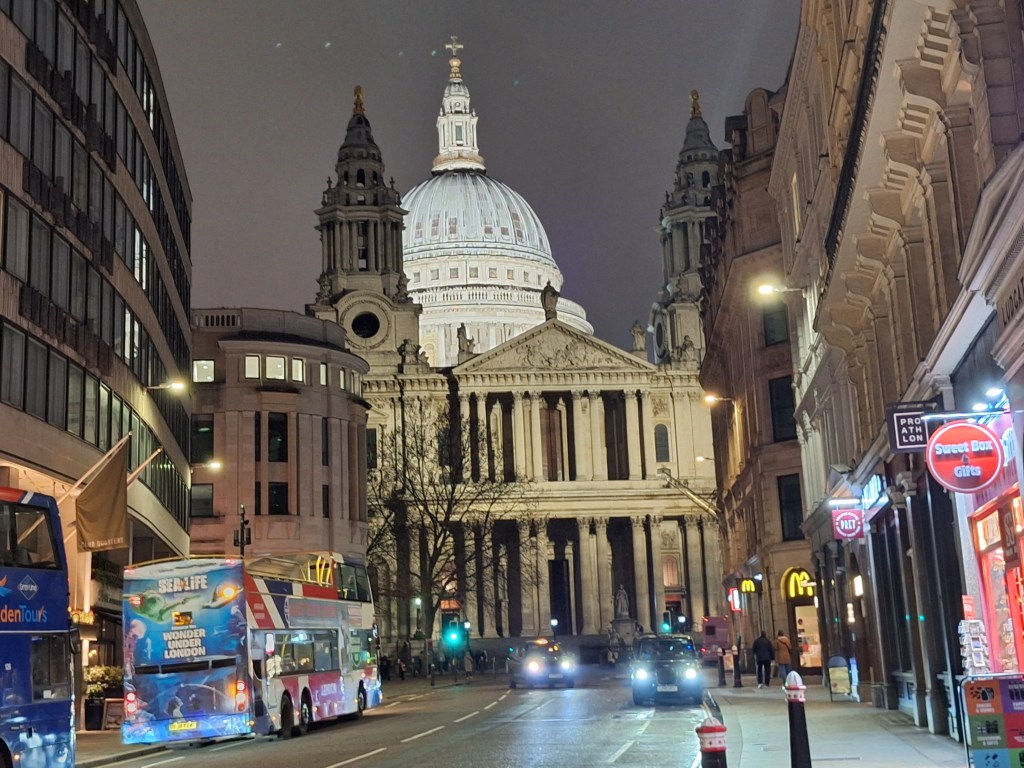
Oh, and I finally got some photos of St Paul’s Cathedral at night:



 Assembly Project
Leave a comment