When confronted with the Cuban Missile Crisis in 1962, John F. Kennedy had on his mind a book that he had recently read. It was The Guns of August, Barbara Tuchman’s newly-published and now-classic account of how the European powers blundered into the First World War. Kennedy was impressed by the book and encouraged many of his advisors to read it. It may have helped him avoid similar mistakes during the tensest moment of the Cold War.
Of course, as Mark Twain supposedly said, history does not repeat, but it rhymes. To use an example Richard J. Evans gives in In Defence of History, when the Bolsheviks came to power, they knew all to well that the English and French revolutions led to the chief of the army seizing power. It was one reason why they conspired to keep their chief of the army, Leon Trotsky, out of power. It did not end well for them.
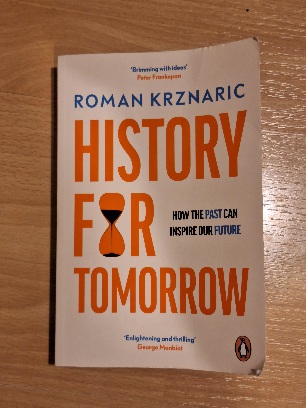
History for Tomorrow: How the Past Can Inspire Our Future (2024) is the latest book by Roman Krznaric (read: “kriz-narrik”), a popular philosopher whose previous books include Empathy and The Good Ancestor. He is also the husband of Kate Raworth, an economist who devised the Doughnut model, a view that economics should be about meeting the needs of people and planet. A true power couple.
This is an episodic book with ten chapters, each discussing a modern issue and ideas of what history can tell us, each focusing on one particular time and place, such as lessons from Edo Japan about building a sustainable society. You can read them in any order you please — as I did.
I like what the book is doing. I would’ve preferred to see more time devoted to the past at the expense of the present. The 23-page chapter on democracy spends more time on its contemporary crisis than the historical examples, each of which are covered for less than two pages. This is often not much time to delve into nuances and alternative interpretations. But the examples it does bring are what make the book worth reading. As food for thought, it’s a feast.
Democracy
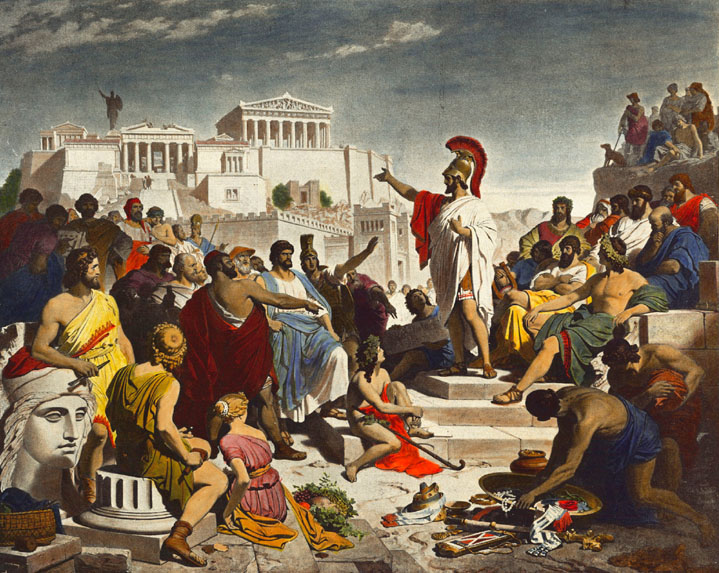
Pericles makes his famous funeral oration to the assembly of Athens.
An article by Krznaric in The Big Issue, published days after the return of Donald Trump, summarises the key points of the book’s democracy chapter. History teaches us that democracy has been present in many different times and places, though virtually always with a degree of oligarchy. The good news is that democracy can work in many different societies. But sometimes it has been very different to what we’re used to.
We’ve tended to assume that democracy and elected governments are the same thing. Yet history gives us examples of democratic governments that had few if any elections.
The obvious example is Ancient Athens, which was governed through an open assembly, open to all, and offices were chosen through sortition (random selection). The Shortest History of Democracy by John Keane includes a more detailed account of Ancient Athens. Less well-known is that many pre-modern city-republics like Venice also used sortition as part of their system of government.
Krznaric mentions the lost city of Djenné-Djenno in present-day Mali, where the archaeological evidence shows it was a highly egalitarian society, with no obvious castles or palaces. Another I’ll mention is that in Ancient India, several states were a ganasangha (republic, literally “tribal assembly”), including the Buddha’s birthplace.
Also worth noting is the remarkable Swiss tradition of popular assemblies. Some of the Swiss cantons (provinces) continue to have open parliaments that all voters can attend to vote on laws. Less well-known is how Swiss small towns and villages make heavy use of open town meetings.
Krznaric’s historical examples point to the same two remedies favoured by this blog: the use of sortition and of open assemblies. Both of which have deep historical roots, but were overshadowed after the 18th century by the view that “democracy = elections”. Krznaric treats this as a triumph of elitism. He has a point that elections are elitist, but it is also important to note that they are one of the few ways you can have have the majority of citizens participate in a modern state. Future forms of democracy will more likely mix elections with sortition and assemblies, rather than replace them.
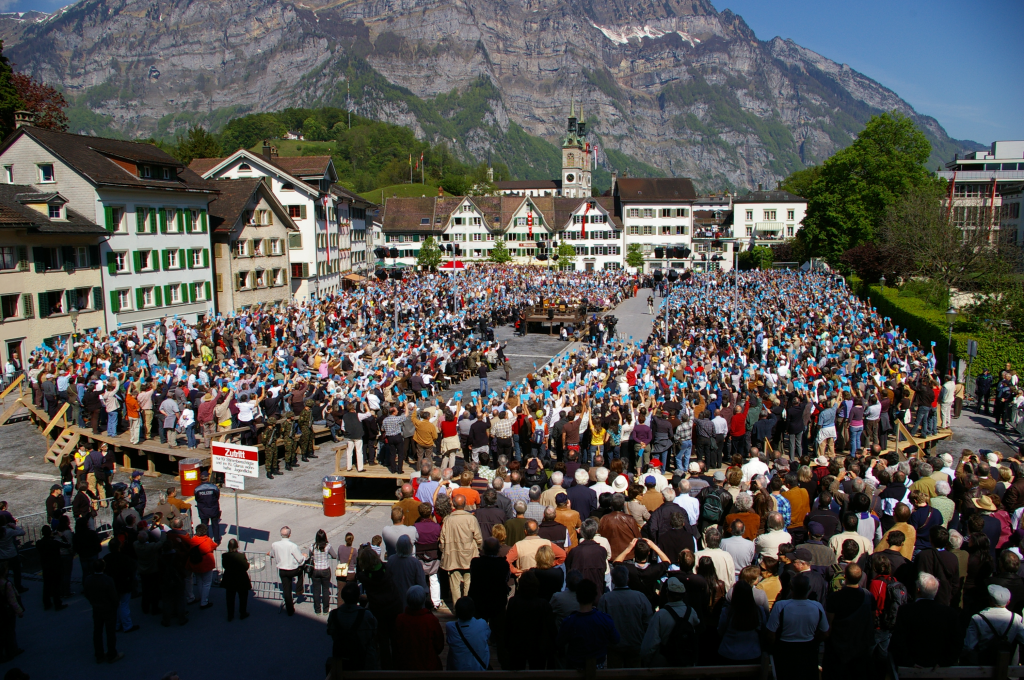
The Landsgemeinde of Glarus – one of the last two remaining open parliaments of a Swiss canton.
Social media
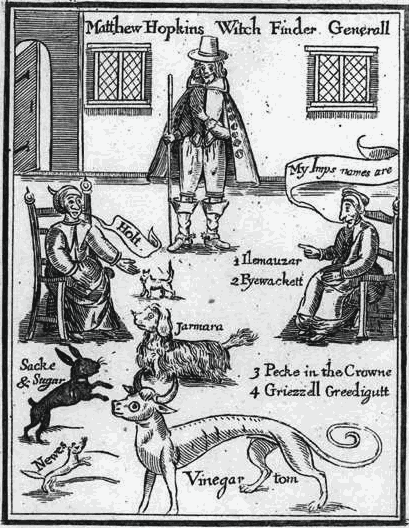
Misinformation in the 17th century: The Discovery of Witches (1647) by Matthew Hopkins, England’s most infamous witch-hunter.
Krznaric also devotes a chapter to “Taming Social Media”. He chooses exactly the era I’d have chosen, how the rise of the printing press shaped Europe from the late 14th century to the 18th. The rise of printing was, more than anything else, the change that ended of the medieval world and ushered in the Renaissance. The result was a staggering success: the number of books and written works exploded. (Western) Europe grew to become the richest region of the world, and the foundations were laid for modernity.
Like all major new technologies, the social effects of printing were also profound. They began with a wave of optimism that it was possible to challenge the powers-that-be and build a fairer society, and at first they seemed to come true. When the German priest Martin Luther wrote 95 complaints against the wealth and corruption of the church, they were spread far and wide. To put in modern terms, Luther went viral.
But this came with a dark side. Instead of uniting to either reform the Catholic Church or go Protestant, Western Europe became bitterly divided between the two. The division fuelled wars that tore apart England, France, the Hapsburg Netherlands and especially Germany and Ireland. Many of these were part of the General Crisis, a period of widespread civil wars in the first half of the 17th century.
Contrary to popular belief, this Renaissance age, not the Middle Ages, was Europe’s main era for witch-hunts. In the Middle Ages, fears of witchcraft were common but never organised into witch-hunts, partly because clergymen were sceptical about them. With the rise of mass printing, pamphlets spread panic about witches, offering instructions on how readers could identify them. Witch-hunters could now organise and spread their beliefs. Their victims were mostly old women who lacked family and friends to defend themselves.
How did civilisation survive, even as printing and literacy became more widespread than ever? Krznaric explores one possible factor, the rise of the coffeehouse culture of the Enlightenment in the late 17th to 18th centuries. Unlike a present day coffee shop, where most people come in alone or with friends and ignore everyone else, these coffeehouses had social gatherings that brought citizens together for respectful discussions on a range of issues. Not all citizens, but the citizens who were rich, literate and male enough to be the kind that mattered.
For only a penny you would be given a bowl or cup of coffee, which you were free to nurse for hours. You might take your seat at a private table or booth, or more likely sit at a communal table, which was a defining feature of the English coffeehouse… There you would while away your time reading newly arrived periodicals, debating the latest news with friends and strangers, and perhaps leave copies of your own writings for others to read.
These face-to-face gatherings allowed people to exchange ideas. We see clear evidence during the Enlightenment of attitudes changing on many different issues, such as growing scepticism that witches existed, but this often can’t be traced to any thinker in particular.
It is plausible that when people with different views talk about them face-to-face, listening and socially bonding, it defuses the kind of division that could be incited by printed media, and in modern times by social media.
Why don’t we have a coffeehouse culture today? The rise of mass media, starting with mass newspapers in the 19th century, took away their role as news hubs. New ways emerged for people to organise politics, such as political parties and trade unions, taking away their role for political organising and connecting. (The clubs of the French Revolution resembled a hybrid between coffeehouses and parties.)
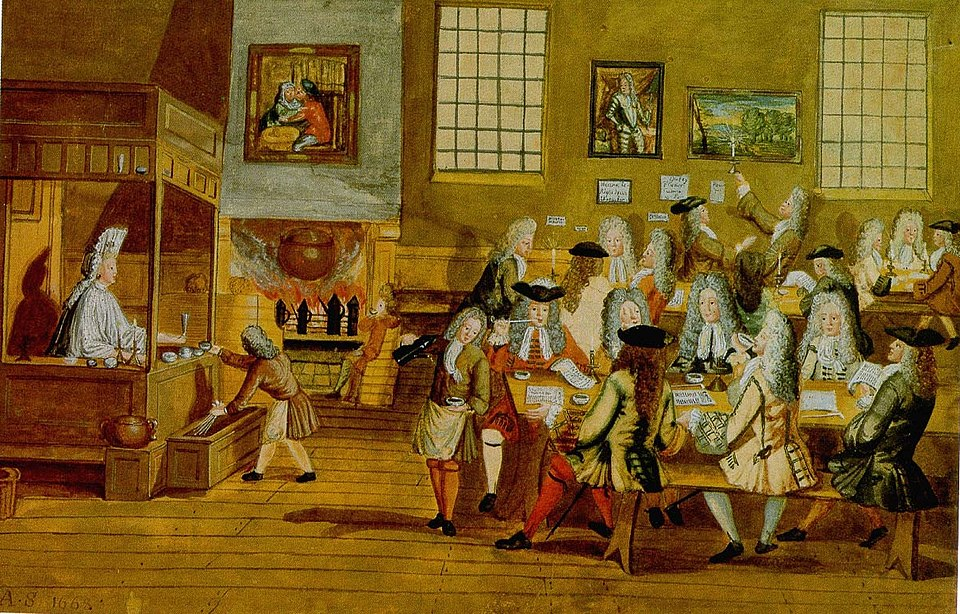
A 17th century London coffeehouse
This trend has intensified in modern times. The rise of social media has increased the sheer volume of media we receive, at a time when we are increasingly isolated from our neighbours. This is contributing to the deterioration of democratic cultures. We cannot afford this any more.
Whether or not they had a role in helping Europe move on from the religious wars, the idea of a modern coffeehouse culture is appealing. It builds on the ample evidence that face-to-face conversations, even short ones, can overcome the effects of divisive media.
When I talk on this blog about people’s assemblies, it may imply a large, impersonal gathering like a school assembly. But they fare best when people are given a chance to talk, share ideas and have a social experience. An important discovery is that these assemblies fare better when divided into small groups, which allows everyone to experience a close, sociable discussion.
In this way, we could build something with elements of the coffeehouse scene that Krznaric describes. Let’s hope it won’t take a century of war to figure out.
Resistance
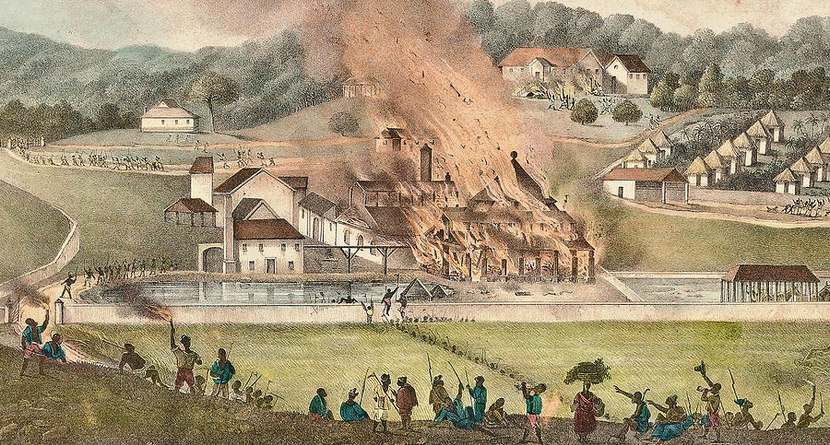
A plantation is burned during the 1831 slave rebellion in Jamaica.
Most people want the government to do more to stop the climate crisis, so why don’t they listen? Part of this may be that it is easy for people to support climate action in a broad sense until the government requires them to pay for a specific change. But it’s clear that part of the problem is that polluters have an outsized influence in our politics, through political donations, lobbying and the billionaire-owned press. When Extinction Rebellion blocked roads in 2018 and 2019, the press focused on the protestors’ unpopular tactics rather than their popular demands. Further evidence is that in the US, where politicians are even more beholden to big money, climate change deniers are more powerful still.
Krznaric looks at the struggle to abolish slavery in the British Empire. The campaign slowly gained traction over more than half a century before being mostly achieved in 1833, under the great reformer Earl Grey. (And also the namesake of a tea, though it’s not clear how.) For a long time, abolitionists faced a decentralised opposition called the West India Interest — the outsized influence that rich slaveowners had in politics.
The Interest found it increasingly difficult to defend slavery. Their lobbyists took to conceding that slavery was wrong, arguing that it needed to be phased out gradually. Even when slavery was abolished, the Interest achieved something of a victory in ensuring compensation would be paid to the slaveowners and not the slaves. In fairness to Grey’s government, this was politically necessary at the time. Krznaric draws parallels between the Interest and Shell, an oil company that has committed to a green transition but only a gradual one, while continuing to be a major polluter.
He discusses the radical flank effect, the theory that major social change requires pressure from radical fringes, even violent ones. In the slavery example, he cites from historians that pressure from slave rebellions was a factor that led to the 1833 Slavery Abolition Act. It also helped that a progressive Whig government had come to power following a recent election. That in turn had been propelled by another case of violence, the Swing riots in the English countryside, so-called because of their leader Captain Swing who didn’t actually exist.
Will it take violence to break the fossil fuel interests? Krznaric acknowledges Erica Chenoweth’s influential research, which has found that non-violent resistance is more effective at bringing regime change than violent resistance. (Chenoweth uses a broad definition of violence, including property damage.)
Krznaric suggests more radical action may be needed, but the historical examples he mentions don’t actually back up his case. There is ample evidence that the militant campaign of the suffragettes hindered their cause, in contrast to their earlier non-militant stunts. The militant Black Panthers were founded in 1966, emerging just as the Civil Rights Movement was running out of battles it could win, and likely because of it.
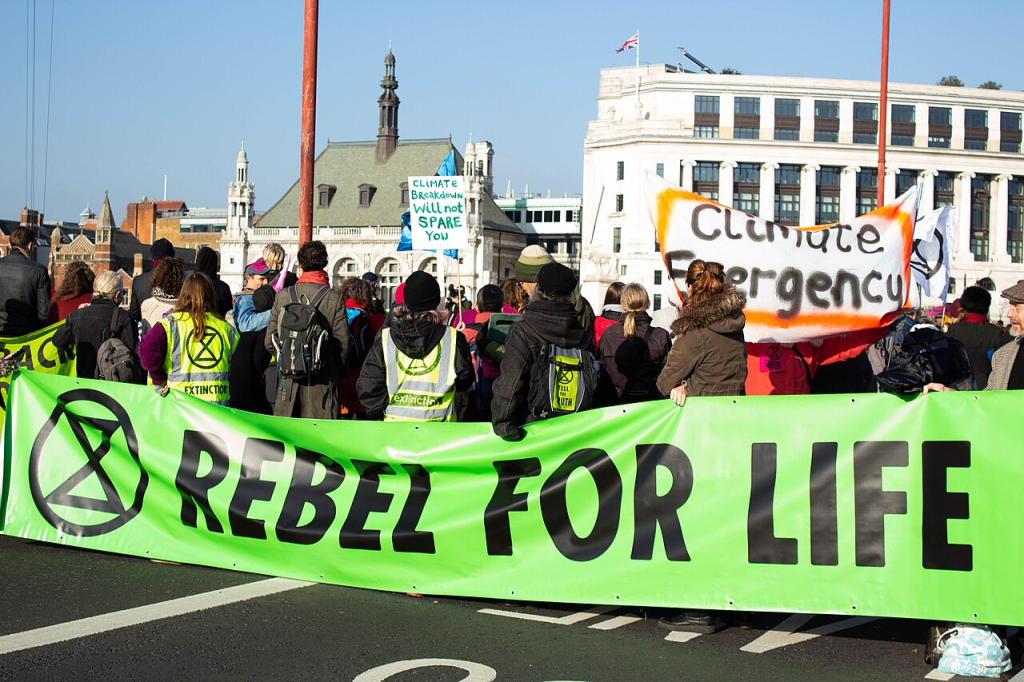
Non-violent resistance — Extinction Rebellion blocks a bridge in 2018.
Radical flanks can be both non-violent and violent, and also organised and disorganised. Krznaric doesn’t quite acknowledge these important differences, which I’d argue are crucial. There could be a case for a non-violent radical flanks; I have sympathised with some in the past like Extinction Rebellion. Whereas as Roger Hallam notes, the problems with organised violent ones are:
- It requires hierarchy, because it requires tight control.
- It requires secrecy, because you can’t afford to have your attack plans leaked.
- It encourages crackdowns by authorities.
- It can encourage extremism within the movement (e.g. the French and Russian revolutions).
- It tends to exclude women and elders, and even young men who don’t like taking part in it.
In the past, violence was more excusable and effective when the system failed. We live in age where disruptive non-violent resistance is a better option. The long-term trend in the past few centuries is an uneven but clear decline in violence, and mass communication makes it easier to build an effective and wide non-violent movement.
But whether radical flanks are good or not, they become inevitable when moderate flanks can’t win. So rather than trying to prevent the rise of radical flanks when stuck with problems like slavery and climate change, everyone else should prepare for them.
Progress
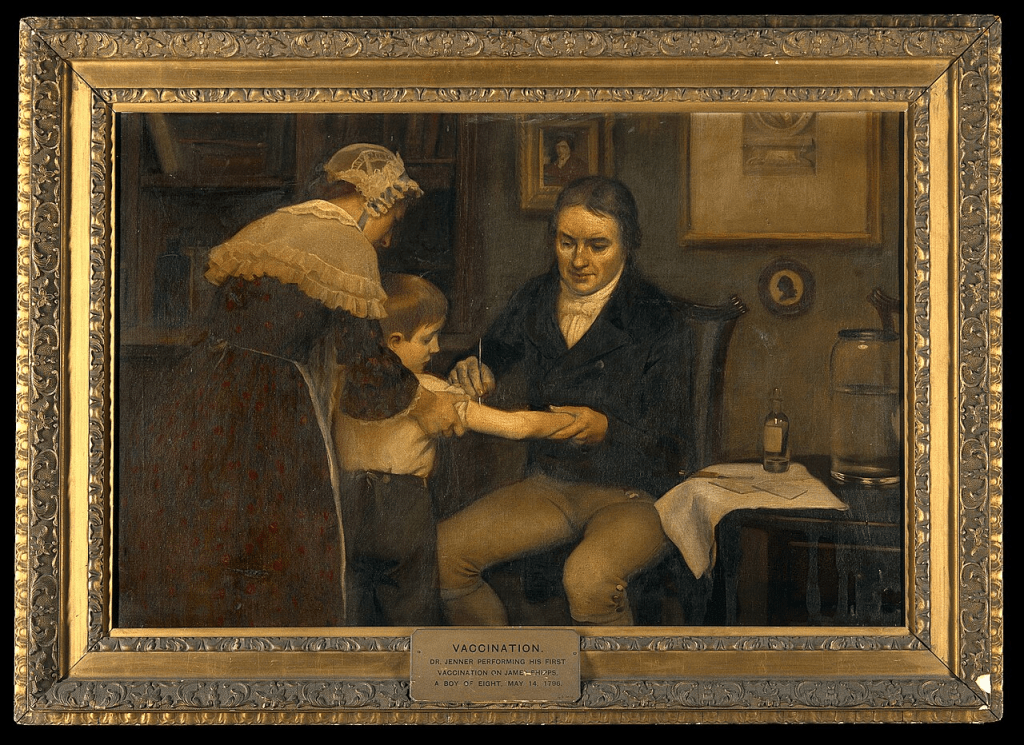
Painting of the first smallpox vaccine. In pre-modern times, smallpox caused at least a tenth of all deaths.
I want to address an undercurrent that runs through the book, an undercurrent of scepticism towards modern Western society and particularly the concept of progress.
On the one hand, one can look at history and see that as more technology has been adopted, the wealth of ordinary people has exploded, life expectancies and literacy have soared, violence has declined and fatal diseases have been eradicated. That, my friends, is progress.
Believing you’re on the “right side of history” can lead to complacency, but it can also be inspiring to activists seeking to improve the world. But is it true? Is progress inevitable? It is at heart a question of free will versus fate. My view is that we should act as though we have free well. If we don’t, it doesn’t matter. But if it actually isn’t, it does. The risks of the latter outweigh the risks of the former. Like Krznaric at the end, I see the value of both “radical hope” as well as actually encouraging people to act.
Nevertheless, history teaches that progress is not linear, and not inevitable at every turn. The most glaring is Europe’s collapse into the barbarism of the two world wars after a century of relative peace. Something like this could happen again. Progress also comes with unexpected consequences, especially how the making of the modern world has caused unprecedented damage to the planet. Though our prehistoric ancestors were not perfect either, on that aspect we have certainly regressed since pre-modern times.
Just like printing, industrialisation in the past, new technology has had unexpected consequences and learning how to manage them has not happened quickly enough. That is a key reason why the world faces the many crises it faces today. History cannot provide all the answers. Indeed, what makes our current challenges with climate and democracy so perplexing is because they are different. But it is a great teacher.





 Assembly Project
Leave a comment