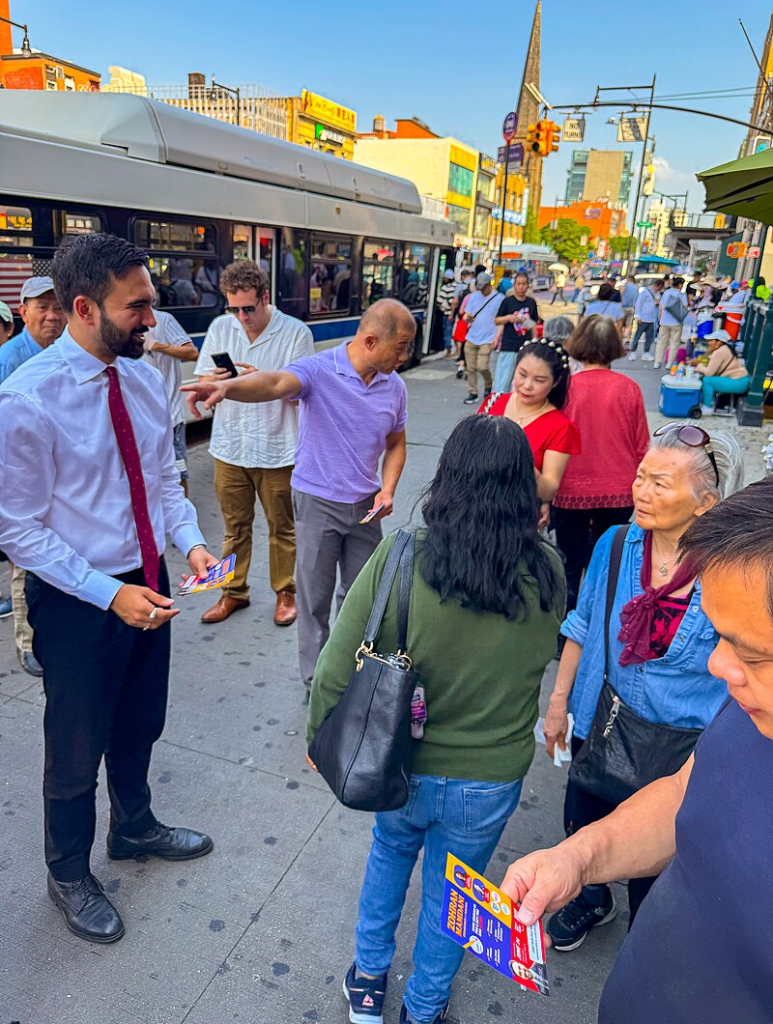
Zohran Mamdani (left) out campaigning in Flushing last June.
The New York City mayoral election has drawn more attention than usual this year, thanks to the initially surprising rise and eventual victory last night of the radical left candidate Zohran Mamdani. At a time when American democracy is declining at an alarming speed thanks to Trump and his supporters, and while its centre left forces are unpopular and discredited, it’s a much-needed inspiration not just to Democrats, but small-D democrats too.
The attention has been international, too. Here in Britain, the new Green Party leader Zack Polanski and the enthusiasm he has been stirring are being compared to Mamdani. It is therefore important to learn from what went well in Mamdani’s campaign.
But it should not be overhyped. New York City is a left-wing bastion. It’s a city where the Democrats’ vote share has typically been over 20 percentage points higher than the national average. What works here may not work in places where the political balance is more typical of the nation, such as the states that elected mainstream Democrats to their governorships on the same day. And there is great uncertainty as to what Mamdani’s victory will lead to.
The system
Like most American elections, the voting system has a primary round, in which party nominees are decided by an open election and is often more important than the second round, the general election, in which all party nominees and any independents compete.
In this case, Mamdani faced two contests with Andrew Cuomo, a centrist Democrat with wide support from the business elites who had been Governor of the wider New York State for 11 years before resigning due to allegations of sexual misconduct. In the primary, Mamdani defeated Cuomo by a 56-44% margin.
Normally, this would’ve been tantamount to being elected mayor. As the city is a left-wing stronghold, a Democratic nominee is virtually guaranteed to defeat a Republican one in the general election. But Cuomo then stood as an independent, attracting a coalition of centrist and right-wing voters; the Republican vote was mostly squeezed out. With over 90% of the vote in, Mamdani is leading Cuomo in the count 50-42%. He appears to have won by a narrower margin than the primary.
Traditional political logic would assume that while a progressive Democrat could beat a centrist one in the primary, where votes are cast by a small, left-leaning minority, they would struggle to win a rematch involving the whole electorate, even in a left-wing stronghold. It would presume that the centrist could easily attract a coalition of right-wing and centrist voters to defeat the progressive.
This is exactly what happened in Buffalo in 2021, when incumbent mayor Byron Brown, a centrist Democrat, lost the primary to progressive challenger India Walton. However, he then ran as an independent in the general election and easily defeated her.
Lessons
There may have been several factors that cause the New York contest to go differently, including the changing national situation, but also the Mamdani campaign’s own strengths. What can we learn?
- Get knocking on doors: The Mamdani campaign built up an army of tens of thousands of volunteers who knocked on over a million doors. Canvassing the most effective thing the volunteers can do and costs nothing. It shows to voters that a party or candidate is a contender, and they will appreciate being listened to. It also helped the campaign that his activist base was regularly speaking to the real voters on the street, rather than trapped in echo chambers on social media or elsewhere.
- Start early. The canvassing had been going on for months before the primary. Too often, canvassing has been seen as something to do in the intense campaign period in the last month before election day. As you can rarely talk to more than six voters in one hour, it means you will reach very few voters in that time. This is why a political movement should be canvassing every month of every year.
- Make it fun. His supporters found the experience enjoyable and sociable. As the Institute of Development Studies put it in the latter link, “the campaign created a participatory culture that made politics joyful again.” This owed as much to grassroots ingenuity as to decisions at the top.
- Use social media well. Mamdani and his campaign were adapt at using social media. Like Ed Davey and his campaign stunts in Britain, they mixed fun with serious messaging. Social media is no substitute for face-to-face conversations, but it can be used to great effect to develop parasocial (i.e. near-social) relations with your followers and others who are interested.
- Avoid unpopular policies. In the Buffalo example, Walton managed to tap into a similar kind of energy, but besides having less ground game, committed to some unpopular policies like cutting police funding. Mamdani avoid this, helped in part because the Defund the Police movement had fizzled out. Mamdani and other progressive figures face a continuing challenge in the future to stay responsive to their electorates.
- Sometimes, radicals outperform centrists. In the past it was assumed that the radical left could never do as well as the centre left. This traditional political logic can often hold, but no longer always. There is a growing benefit in American and other countries’ politics to politicians who come across as more authentic than a regular politician, and a growing proportion of the Republican vote has been a “generic screw-the-establishment vote” which could just as easily go to a socialist as a demagogue. This is why although the last minute squeeze of the Republican vote went mostly to Cuomo, Mamdani also outperformed the pre-election polls. It may be one reason why Bernie Sanders did well in conservative rural counties and open primaries during his presidential campaign. A similar reason might be why in Britain, the Labour Party gained voters and seats in 2017 with a new leader who was more left-wing, though they fared worse in 2019.
- Grassroots energy can defeat big money. American election campaigns are expensive and Cuomo’s was no exception, drawing much support from billionaires who were trying to stop Mamdani. There is little sign that expensive adverts worked, and studies have shown again and again that they have little effect. Some ads got very dirty, attacking his Muslim faith and support for Palestine but there is little sign they resonated; Mamdani’s support for Palestine is more in touch with the city’s voters. The Mamdani campaign focused on canvassing and social media, which costs nothing if it’s volunteers.
- Focused on kitchen table issues. Moreover, few voters care much about abstract concepts like socialism or democracy. Rigidly partisan voters are less common than you think, dwindling in number and unlikely to change their behaviour. Most voters care about things that affect their lives directly. Mamdani’s policies were radical and each based on dealing with one of those issues, like childcare, public transport and the costs of housing and living. This was likely possible because of the conversations he and his supporters had done with voters.
What next?
There are still many unanswered questions. To repeat, New York is a left-wing bastion, so it is not clear whether this offers lessons about winning in the rest of the country. I suspect that radical left candidates can win in America, but they must offer real power to the people, inspire their followers, knock on doors and offer policies that resonate rather than alienate. In other places, the policies required may be different and there may be risks to using the word “socialist”. Or there may not.
Then there are the questions of how he can deliver. Like many American movements from Obama to Trump, the Mamdani campaign was built to win the executive branch without targeting the legislative. Many Democrats in the City Council might welcome the mandate to be radical, but could he get their votes if very few of them are directly allied with him? Would he be trapped between working with elite factions and being true to himself, or between his more radical supporters and the rest of the public? Would he be able to balance the benefits of his personal charisma with the dangers of having a movement dependent on one man? Many of his proposals are expensive, so would he be able to raise the money to do them? A few are not good ideas; even left-leaning economists like Paul Krugman have criticised rent control for reducing the supply of housing for the benefit of a privileged class of insiders.
Consider Bill de Blasio, a previous progressive to hold the mayorship, albeit not quite as radical. He had positive achievements such a childcare program, but his legacy was some way from the high hopes of his landslide victory in 2013 and no progressive managed to succeed him. Consider the parallels that has too with Obama. In both cases, they were blocked from achieving their original inspiring vision by the sclerosis of the existing power structures.
Every single one of these things pose all challenges that could lead to a similar decline, or worse. And that’s assuming that rule of law and democracy survive in the United States. Trump’s threat to block federal funds to the city highlights what may happen if they don’t.
On the bright side, Mamdani has built his campaign without being dependent on those structures, and his voters will probably care less about ideology and specific promises than whether their lives are improving.
And there are ways to cut through all these challenges. For example, New York could follow Paris in creating a permanent citizens’ assembly to find good solutions in a way that draws advice legitimacy from the public. The Mamdani campaign could also put its new infrastructure and power to use. It could help organise communities to create community groups and campaigns, and agitate for change through methods such as rent strikes and tax strikes. Above all, a lesson from a book I lately read is that a movement that promises more equality must promise more democracy. Lastly, it is important not to have socialism in one city, but for similar movements to get organising in the rest of the country — and the world.


 Assembly Project
Leave a comment