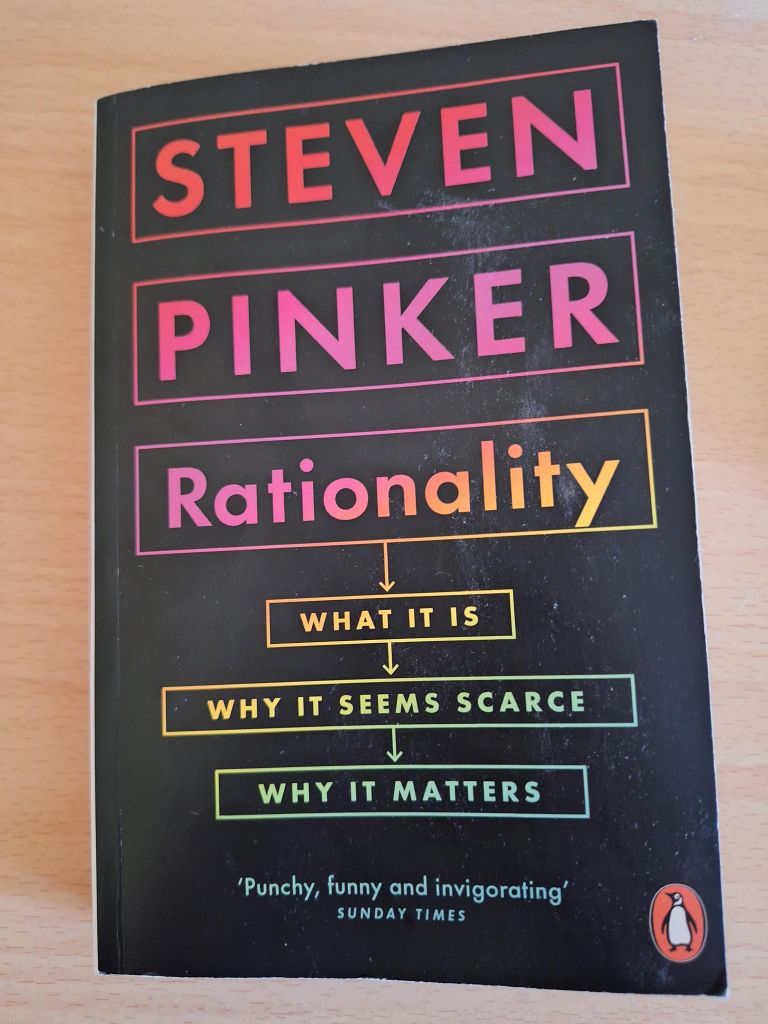
Steven Pinker has written some cracking books on how the human mind works, as well as in defence of liberal democratic and progressive values. The most recent is titled Rationality: What It Is, Why It Seems Scarce, Why It Matters (2021).
What is rationality? Pinker defines it as “the ability to use knowledge to attain goals”, that is, using “justified true belief”. It’s about making decisions without being misled by emotion, tradition, superstition, prejudice and a host of cognitive biases in the human mind. This definition does not make a judgement on whether the goals themselves are worthy. This is not a bad idea, as people have different ideas about what they want in life.
What I liked about the book was that Pinker doesn’t put humans down. Yes, we do have major blind spots. A larger book could be written on every possible cognitive fallacy, including the fallacy fallacy. But he argues that humans are more surprising for how rational they are, whether in tribal societies or modern states. Pinker is once again making the case for things that seem too naïve and optimistic to be true, and yet… There is a lot to be said for them.
Perhaps more informal in tone than some of his previous books, his points are delightfully illustrated with cartoons and quips. This was my favourite of the cartoons. Occasionally it can get a bit technical such as when he’s explaining the different types of linked probability, but there’s nothing that doesn’t come together with a reread. He offers a clear explanation on the Monty Hall Problem, although I wouldn’t know whether that’s enough to explain the answer to the most counter-intuitive maths problem ever devised.
Mythological beliefs
All the books I review here are linked in some way, however tenuous, to assembly democracy. This one is no exception, only because Pinker offers one of the best explanations for why people believe things that are outright nonsense, an important lesson for assembly facilitators. Many of these beliefs not only go against verifiable fact, but also don’t even make sense on their own assumptions, either:
Three quarters of Americans believe in at least one phenomenon that defies the laws of science, including psychic healing (55 percent), extrasensory perception (41 percent), haunted houses (37 percent), and ghosts (32 percent)—which also means that some people believe in houses haunted by ghosts without believing in ghosts.
In a chapter titled “What’s Wrong with People?”, Pinker argues that humans have two mindsets, drawing on earlier interpretations by Hugo Mercier, Dan Sperber and Robert Abelson. Pinker refers to them as a reality mindset and a mythological mindset. Reality beliefs are things that affect what we do in our daily lives, such as:
- “There’s a table front of me.”
- “I’m hungry.”
- “If I don’t do better at work, my boss will fire me.”
- “A bus is hurtling towards me.”
Mythological beliefs are different. They are about things that are distant from our daily lives. They are not built on logic and observation. They are often based on emotions, stories, traditions, moral messages — and prejudices. They include:
- Religion, such as belief in God or an afterlife.
- Conspiracy theories, such as JFK theories or QAnon.
- National myths, such as the heroism of George Washington, Winston Churchill and Charles de Gaulle.
- Certain political ideologies.
Pinker points out that people may believe in these things, but they don’t act as though they’re true. You don’t get many Christians waging wars to convert non-believers, or supporters of the identity synthesis resigning their posts so that the minorities can take them. A few examples of my own:
- Elvis Presley has been treated as legally dead.
- No-one has been convicted of a conspiracy to assassinate John F. Kennedy, despite the long and wide popularity of these theories, nor for Princess Diana.
- The Bolsheviks founded a communist regime in Russia, the poorest major country in Europe, even though Karl Marx’s theories suggested that communism would take root in wealthy, industrial countries first.
- Multiple religions include belief in a happier afterlife, but you don’t see their followers dying in mass suicides to get there.
- Many British activists admire the suffragettes but do not imitate their more militant methods.
- You don’t see people using toilets of a gender that they don’t look like but “identify” as.
It’s also why conspiracy theorists rarely report their allegations to the police. Perhaps that’s a bad idea if your country or world is being ruled by an near-omnipotent oppressive regime. Yet conspiracy theorists don’t act as if that’s true either; I’ve met people who had no qualms blabbering their theories to people they barely knew or on social media where they could clearly be traced. As Pinker wryly notes, “It’s not the strategy you see from dissidents in undeniably repressive regimes like North Korea or Saudi Arabia.” Oliver Stone even made a $40 million Hollywood film with A-list stars!
Many people with beliefs that sound crazy are able to have very normal jobs and lives. But there are dangers. The real and mythological can get crossed. We’ve seen this throughout history, from the religious wars and pogroms of the past to the terrorist attacks and far-right riots of the present. One QAnon supporter actually did go to the pizzeria and threaten them with a gun. But only one out of millions.
To add a point of my own, even when people instinctively know the difference between their reality and mythological beliefs, outsiders won’t. Pinker notes how nationalists and religious believers can clash with historians who examine their mythological beliefs through a factual mindset. Though QAnon supporters failed to act as though they were taking their beliefs seriously, that’s not how it looked to the other side. Or look at the anti-trans backlash. Much of it is reacting against a movement’s mythological beliefs, not to how real trans people behave.
When the irrational is rational
What is the point of mythological beliefs? Most likely, it was a way of coping with things they couldn’t understand, like the weather, the shape of landscape, the biology of plants and animals, and the meaning of life. If enemy tribes didn’t share them, they may have also helped foster a sense of social cohesion and purpose.
Today, science has given us factual explanations for many of these things. But there are still some things science can’t give us, like a sense of meaning and purpose. And even when things can be explained with a reality mindset, very few people have the in-depth understanding of it, even in the most educated socio-economic groups. That may lead to people viewing it with a mythological mindset.
Politics is an example. Some people view it with a reality mindset, such as politicians, journalists, political scientists and even this blog. But most people haven’t taken the time to study how it can be explained this way. And why should they, given that they don’t have that much of a say? Thus many of us have a good reason to view it with a mythological mindset.
The bad news is that despite the wide and rising education levels, people’s willingness to hold irrational beliefs doesn’t seem to have gone down. The good news is that it doesn’t seem to have gone up, either. The real challenge caused by the rise of the internet and then social media is that it has given conspiracy theorists a chance to link up.
Pinker responds by saying:
[F]or all the vulnerabilities of human reason, our picture of the future need not be a bot tweeting fake news forever. The arc of knowledge is long, and it bends towards rationality. We should not lose sight of how much rationality is out there.
There is something to be said for his long-view optimism and suggestion that we should educate people on the importance of rational thinking, though they’re far from an answer to a situation that even Pinker can’t fail to notice is concerning.
Learning to live with it
It is probably impossible – and perhaps not desirable – to eliminate mythological beliefs altogether. We should focus instead on making sure that they do not take control of society or tear it apart. People need to trust one another so they can have shared factual beliefs about things they can’t see. Otherwise, how can we even be sure that the German city of Bielefeld exists?
Could assembly democracy help? In my limited experience with people’s assemblies, I have heard only warm, respectful debate which found much common ground. The relatively easier political climate of Salisbury may have helped. It will be interesting to see if it’s different during my upcoming visit to an assembly in Hull, a city with growing support for the far right. One of the organisers there has vouched for their “empowering and healing” effects.
I think the reason why is because they encourage people to shift into the reality mindset. Those who buy into problematic beliefs will have their prejudices challenged, reducing the chance that those believes will be crossed with reality, while others will see the contradiction that someone can have those beliefs but not act on them. We may not always agree on everything, but we can agree where it matters.




 Assembly Project
Leave a comment